Tests slow down development
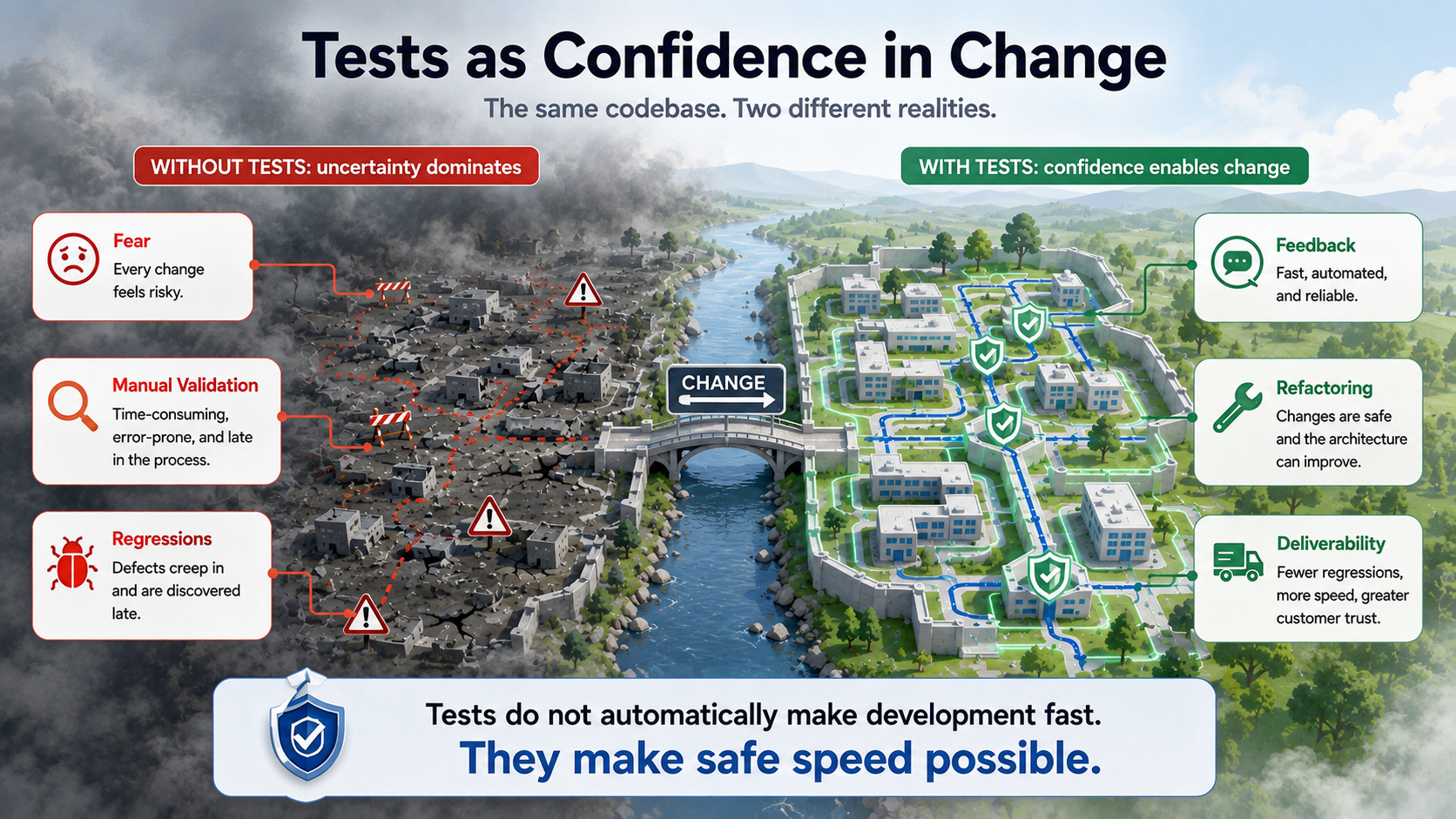
It’s not tests that slow down development. Fear of change does.
The sentence sounds reasonable at first:
We don’t have time for tests.
It sounds like pragmatism. Like delivery pressure. Like focusing on what matters.
Often it means something else:
We don’t have time to build confidence today. So we pay tomorrow with manual checking, regressions, fear, and slower changes.
That’s the real fallacy.
Tests aren’t extra work tacked on after development. Good tests are part of development, because they make behavior checkable.
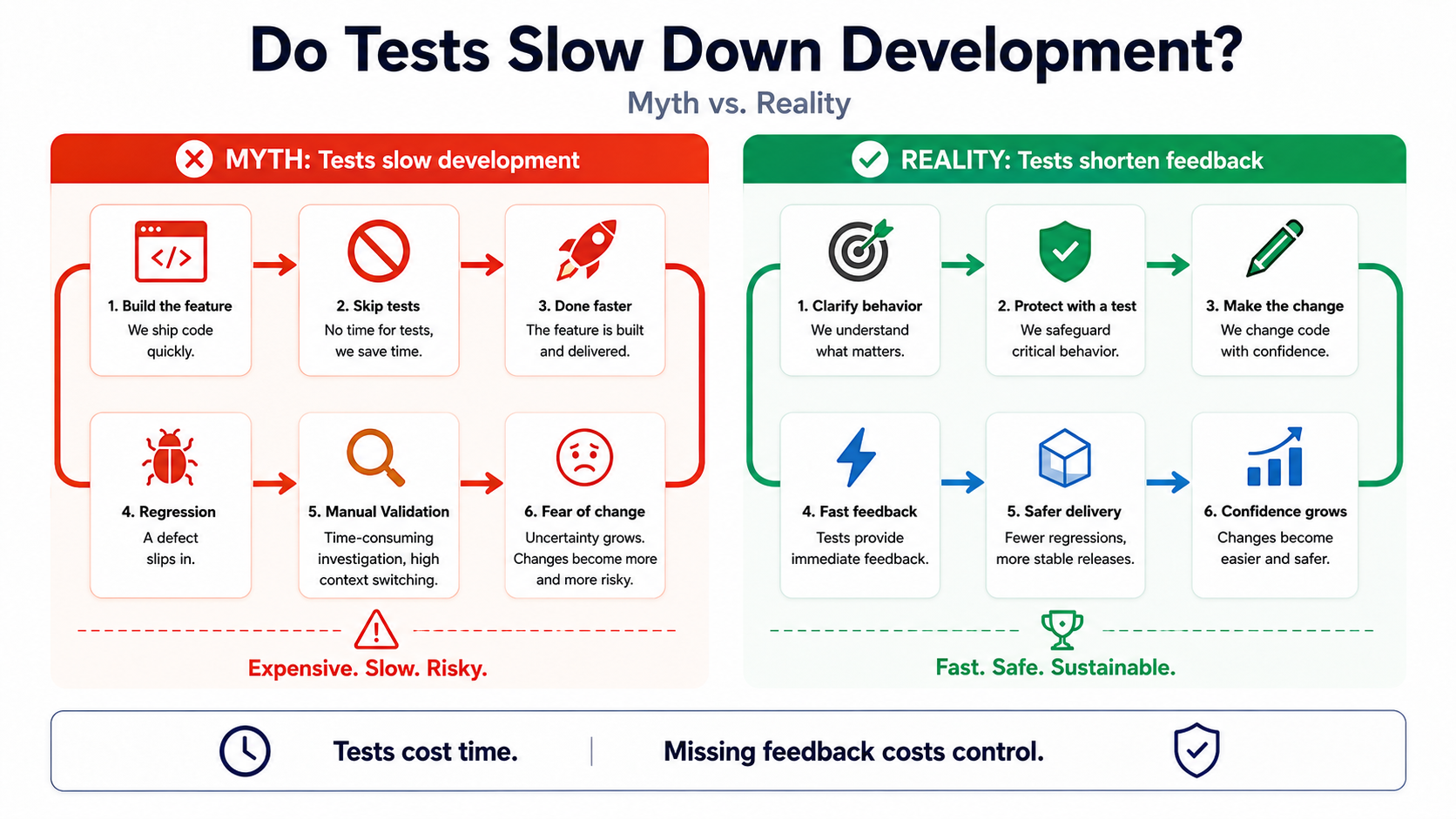
The myth only sounds right in the short term
Section titled “The myth only sounds right in the short term”Of course tests cost time.
A test doesn’t write itself. It has to be understood, built, maintained, and sometimes deleted.
But the relevant question isn’t:
How much time do tests cost?
The better question is:
How much time does it cost us to not trust our changes?
Because without tests, the effort doesn’t disappear. It just moves.
Then someone checks manually later. Then people guess during review. Then it gets caught during acceptance testing. Then the customer finds the bug. Then everyone gets nervous at the next refactor.
The team saves a few hours up front and pays for it later with uncertainty, context switching, regressions, and a growing fear of touching the code.
That feels faster at first.
Until every change becomes a small act of courage.
Tests are a feedback system
Section titled “Tests are a feedback system”Tests aren’t an end in themselves.
A test is valuable when it makes feedback faster, earlier, or more reliable.
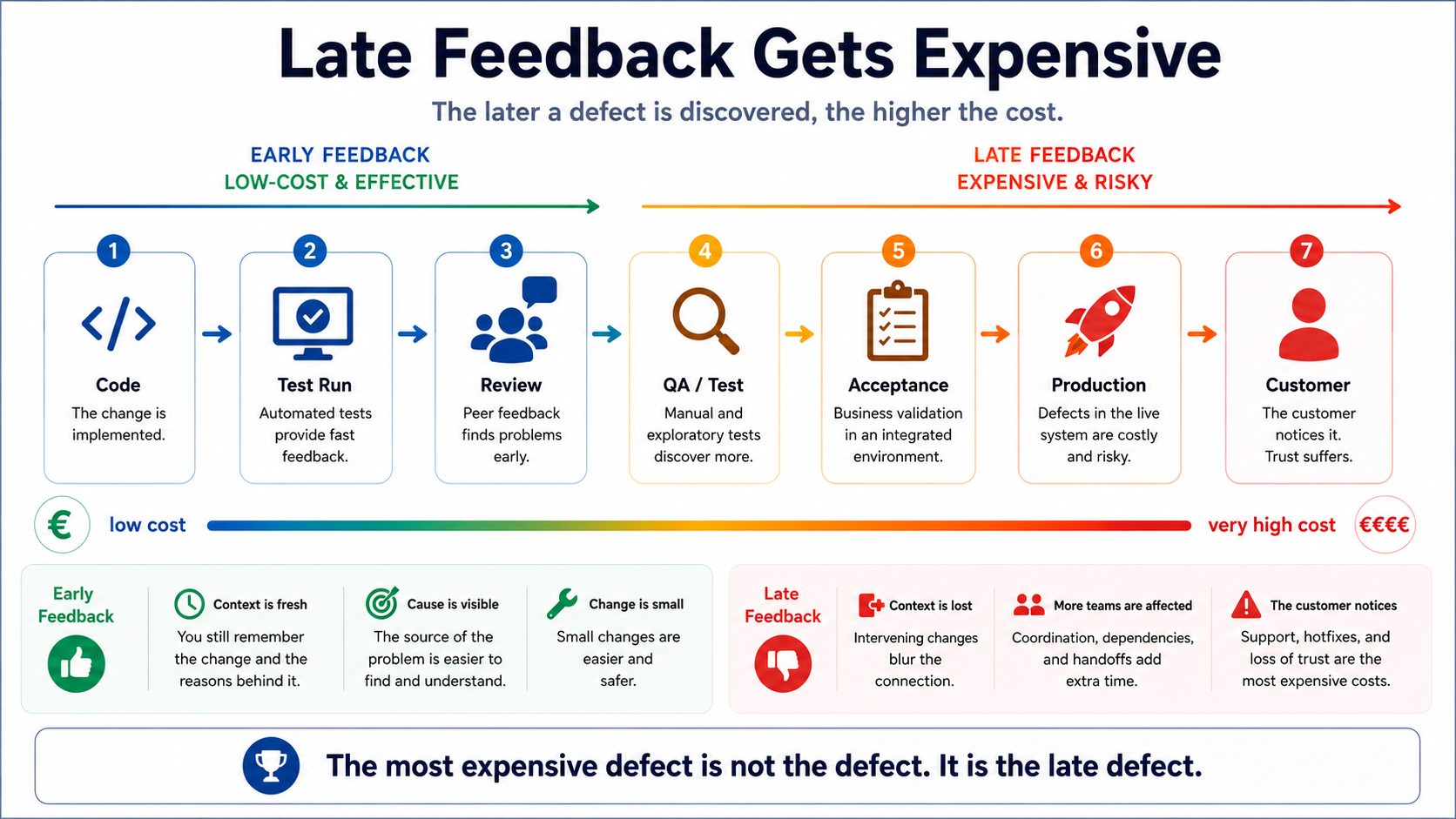
Without automated feedback, you often notice problems late:
- during manual testing
- during review
- during acceptance
- in the next sprint
- in production
- from the customer
- during the next restructuring
The later feedback arrives, the more expensive it gets.
Not because the bug magically gets bigger. Because more context gets lost, more people get pulled in, more trust gets damaged, and more follow-up work piles up.
Tests are a safety net for architecture work
Section titled “Tests are a safety net for architecture work”This becomes especially visible during architecture work.
Refactoring. Removing DTO leakage. Untangling components. Cleaning up state management. Sharpening module boundaries. Strangling legacy code. Cutting cleaner interfaces.
All of that sounds reasonable.
Until someone asks:
How do we know everything still works afterward?
If the answer is “we don’t,” bad architecture stays exactly where it is.
Then nobody refactors. Then people build around it instead. Then the component gets even bigger. Then the store gets even more tangled. Then the DTO gets passed even deeper into the frontend.
Not because nobody sees the problem.
Because nobody can change it safely.
In situations like that, tests aren’t decoration. They’re the difference between:
We know what we’re changing.
and:
Let’s hope it doesn’t fall over.
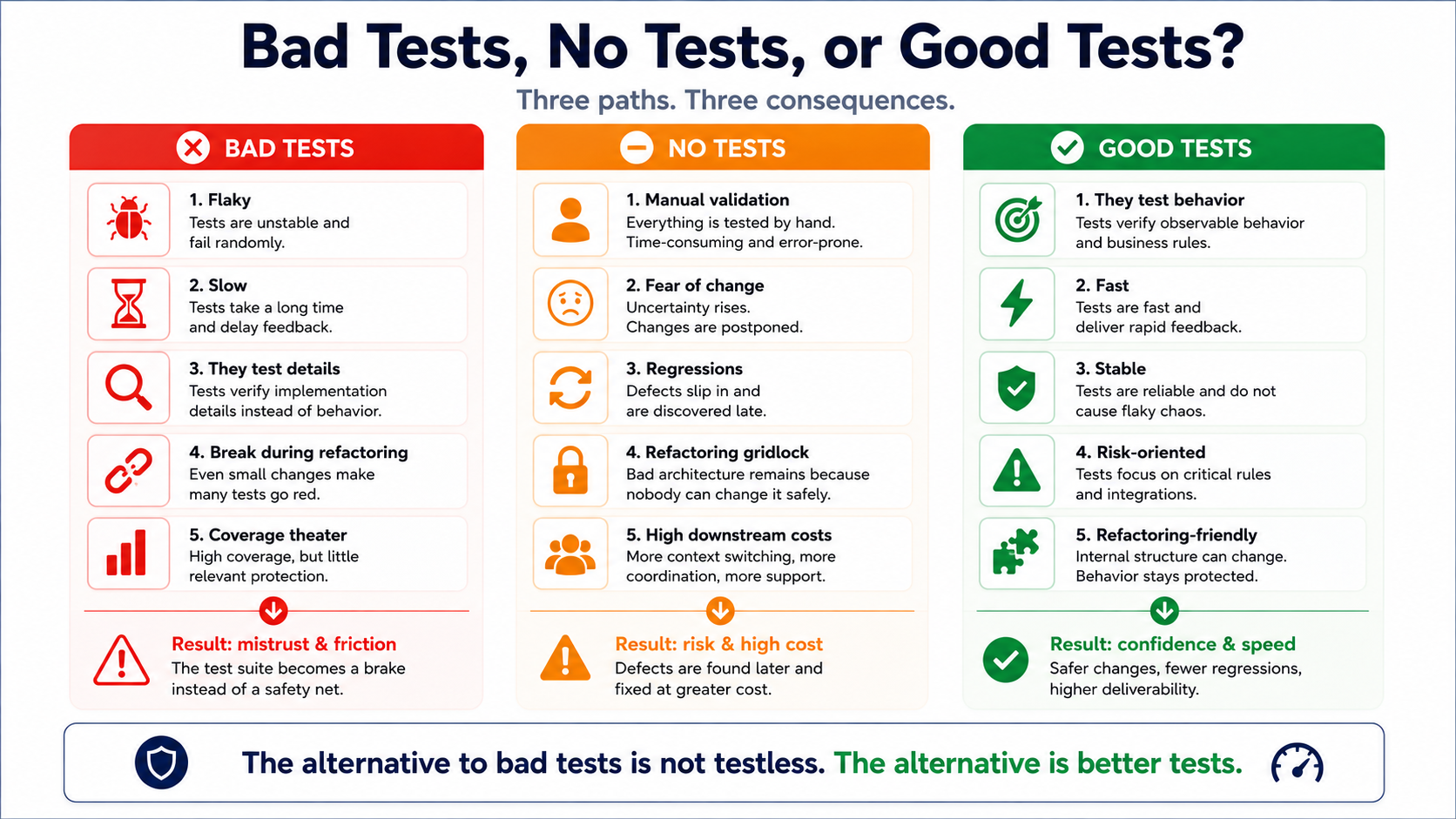
Bad tests really do slow you down
Section titled “Bad tests really do slow you down”The claim that “tests slow you down” isn’t completely wrong.
It’s just too vague.
Bad tests really do slow you down.
Tests that check CSS classes. Tests that pin down private methods. Tests that lock in framework quirks. Tests that break every time you touch the internals. Tests that are slow, flaky, and impossible to follow. Tests that only exist to make a coverage number look good.
Tests like that don’t help. They make people distrust the test suite.
Then every green build gets side-eyed. Every red build gets waved off as “probably flaky again.” Every change needs test upkeep with no real payoff.
That’s not quality assurance.
That’s bureaucracy with assertions.
The important point is:
Bad tests aren’t an argument against tests. They’re an argument against bad tests.
Good tests protect behavior, not implementation
Section titled “Good tests protect behavior, not implementation”Good tests don’t care how elegant the code looks on the inside.
They care about what observable behavior has to stay intact.
A good test says:
When this business scenario happens, this observable outcome has to follow.
A bad test says:
This private method has to be called with exactly these parameters, even though nobody outside the code cares.
The difference is huge.
Good tests help with refactoring, because they let you change the internal structure without losing behavior.
Bad tests block refactoring, because they confuse internal structure with behavior.
Good tests document examples. Bad tests document accidents.
Good tests reduce risk. Bad tests preserve fear.
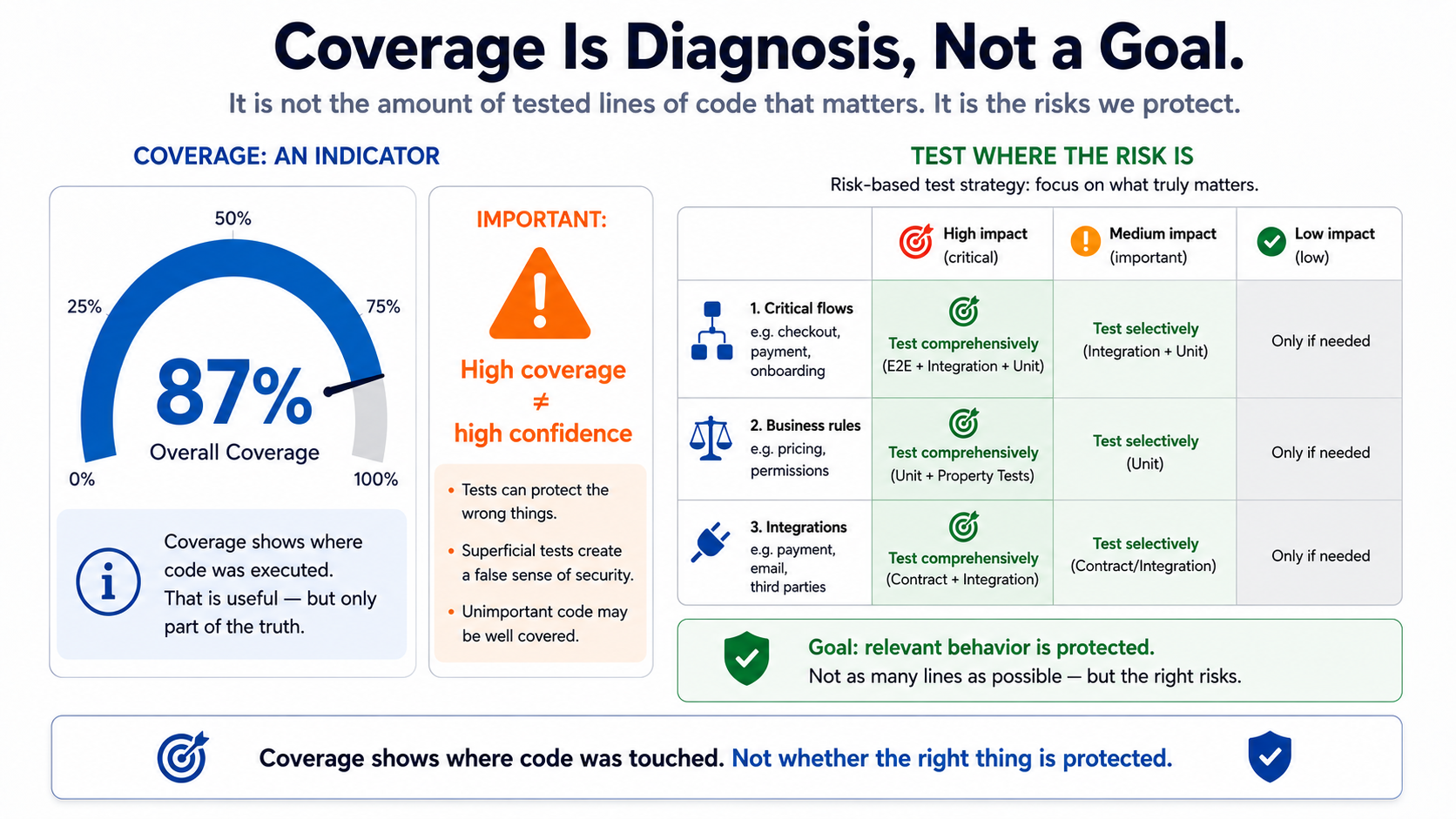
Coverage is a diagnosis, not a goal
Section titled “Coverage is a diagnosis, not a goal”Coverage is useful.
It can show which areas never get touched. It can surface blind spots. It can help start a conversation.
But coverage gets dangerous once it becomes the goal.
If “80 percent coverage” is the goal, the team optimizes for 80 percent coverage.
Not necessarily for reducing risk.
Then you get tests that execute code without checking anything that matters. Getters get tested. Branches get mechanically touched. Mocks confirm mocks. Snapshots get updated without anyone knowing whether behavior actually broke.
Coverage says:
This code got touched.
Coverage doesn’t say:
This important behavior is protected.
That’s a difference that gets expensive on a lot of projects.
Not every risk needs the same kind of test
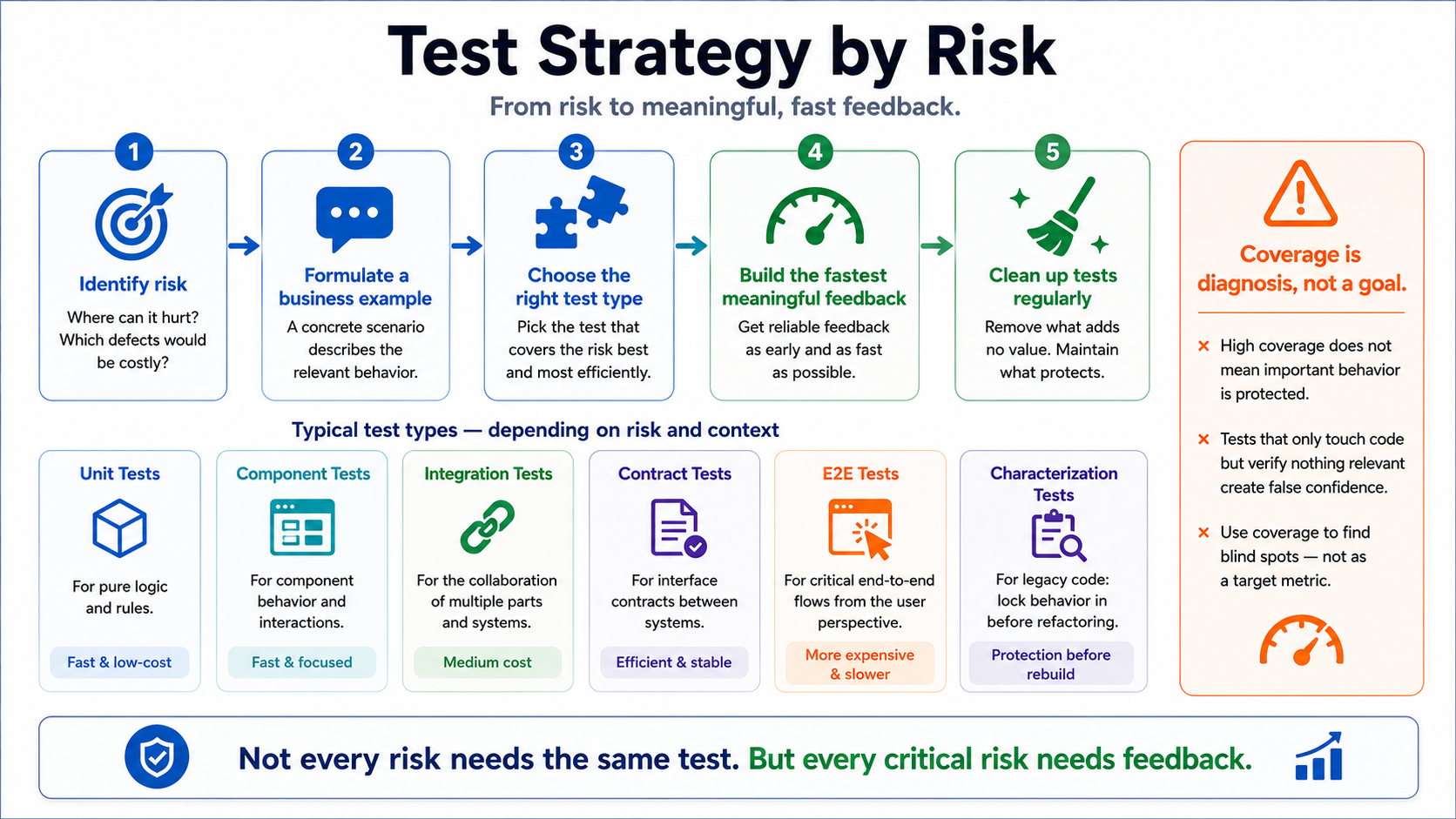
Section titled “Not every risk needs the same kind of test”The testing pyramid is a useful heuristic.
Lots of fast tests at the bottom. Fewer slow, expensive tests at the top.
But the testing pyramid isn’t a law of nature either.
The more practical question is:
Which risk are we trying to cover?
Clear logic usually calls for fast unit tests.
Component behavior can be checked reasonably well with component tests.
Critical interfaces need integration tests or contract tests.
A handful of core user journeys deserve end-to-end tests.
Legacy code sometimes needs characterization tests first, so existing behavior becomes visible before anyone touches it.
Not every risk needs the same type of test.
But every critical risk needs some form of feedback.
Management needs tests precisely because of speed
Section titled “Management needs tests precisely because of speed”Management wants speed.
That’s legitimate.
Products have to ship. Budgets are limited. Planning needs reliability. Customers don’t wait patiently for a team to find its inner architectural harmony.
But that’s exactly why tests matter.
Tests aren’t a luxury for developers who enjoy looking at clean code.
Tests are a mechanism that keeps you from losing your ability to deliver every time something changes.
The better question for management isn’t:
Why are you writing tests?
It’s:
What risk do these tests cover?
Or:
What change do they make safer?
Or:
What manual checking do they replace?
Or:
Which regression would be expensive if it surfaced late?
That shifts the conversation away from how many tests exist and toward managing risk.
And that’s exactly where it belongs.
A sound test strategy isn’t dramatic
Section titled “A sound test strategy isn’t dramatic”A good test strategy doesn’t have to be dogmatic.
It doesn’t have to wave around 100 percent coverage. It doesn’t have to solve everything through TDD. It doesn’t have to chase every click with an end-to-end test. It doesn’t have to freeze every private function in place.
Above all, it has to be honest.
Which business rules are critical? Which integrations are dangerous? Which regressions would be expensive? Which areas change often? Which legacy spots is nobody willing to touch? Which tests are slow, flaky, or worthless?
That produces a practical target state:
- identify risks
- collect concrete business examples
- cover critical logic with fast tests
- target dangerous integrations deliberately
- characterize legacy behavior before refactoring
- focus end-to-end tests on a few critical flows
- fix or remove flaky tests
- treat coverage as a diagnosis, not a goal
That’s less dramatic than test dogma.
But a lot more useful.
The better sentence
Section titled “The better sentence”“Tests slow down development” is too blunt.
Better:
Bad tests slow down development. Good tests limit risk. Missing tests push the cost into the future.
Or, shorter:
Tests aren’t a brake. Bad tests are. Skipping tests is a loan. And fear of change is the interest.