Frontend isn't backend with a coat of paint
Frontend isn’t the decorative output of backend data.
It’s not “a little bit of Angular.” Not “just a form.” Not “the surface you slap on afterward.”
Modern frontends are interactive, asynchronous, state-driven applications. They respond to user intent, API responses, errors, permissions, loading states, routing, validation, real-time changes, product logic, and sometimes design decisions born somewhere between Figma, Jira, and the coffee machine.
Anyone who approaches this world with purely imperative reflexes ends up fighting the framework at every turn.
And that’s exactly what happens in a lot of projects.
Seasoned software engineers. Good backend developers. Experienced people with clean structural thinking, real discipline, and genuine technical understanding get dropped into frontend work, just like that.
Not because they’re unsuited to it.
But because organizations believe frontend is just backend with a coat of paint.
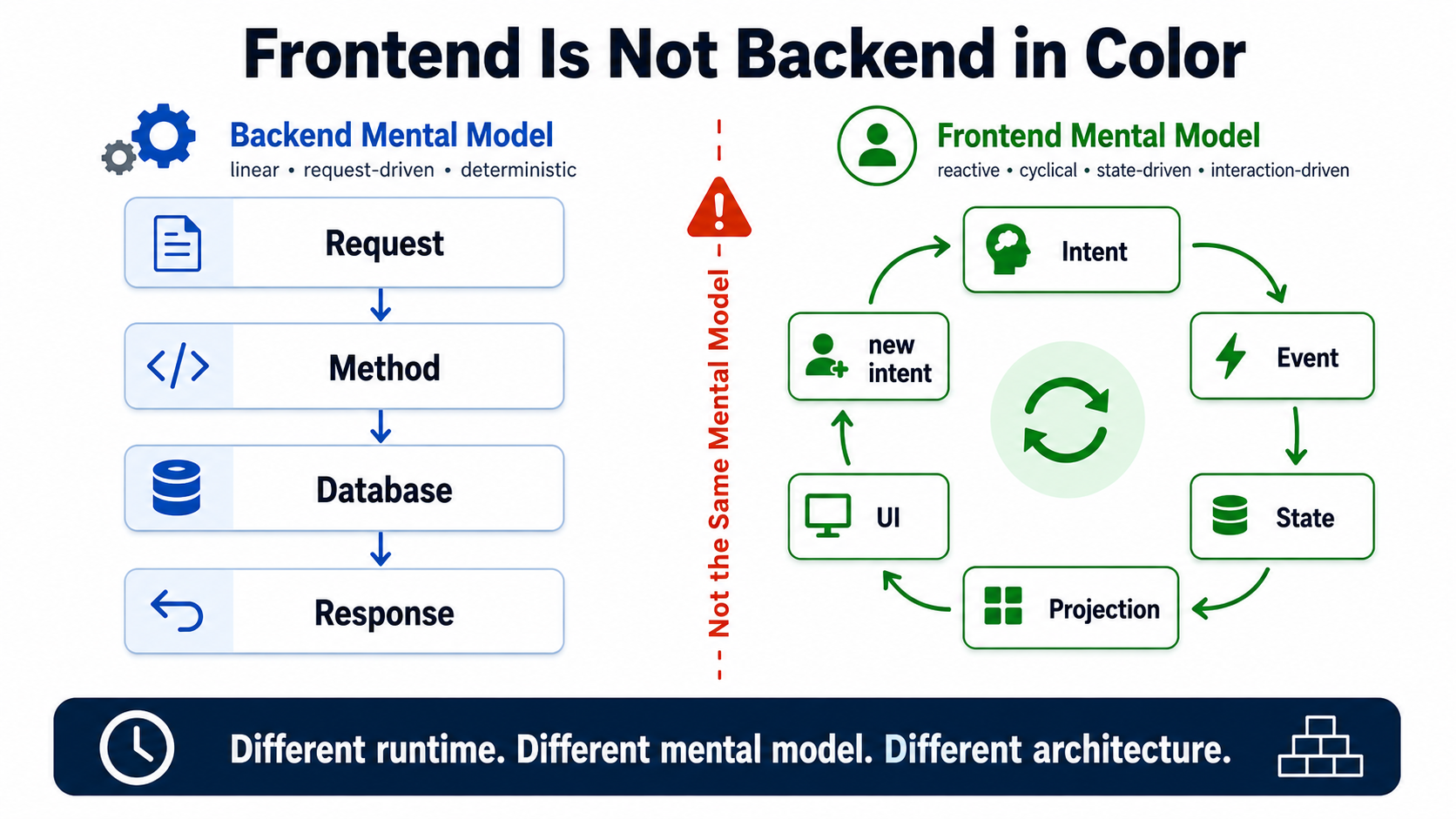
The myth: good developers can obviously do frontend too
Section titled “The myth: good developers can obviously do frontend too”Of course good developers can learn frontend.
The question is just: under what conditions?
In a lot of organizations, it sounds roughly like this:
“We already have developers. They can do frontend too.”
That sounds pragmatic. Almost efficient.
Until you look closer.
Then pragmatism quickly turns into architecture debt on a payment plan.
Because frontend isn’t just syntax. Not just components. Not just HTML with a TypeScript attachment. Frontend has its own runtime model, its own risks, and its own forms of complexity.
A developer who’s spent years thinking in backend systems brings valuable strengths:
- data modeling
- understanding interfaces
- error handling
- testing discipline
- security awareness
- transactional and integration thinking
- a good instinct for structure
All of that is useful in frontend work.
But it has to be translated.
If you just copy backend patterns into UI code, you get something strange: not a good backend and not a good frontend.
Just backend thinking wearing a UI costume.
It sort of works
Section titled “It sort of works”Building frontend with purely imperative reflexes is a bit like traveling to China and speaking German the whole time.
You can get by with hand gestures and pointing.
You might get food. You might find the train station. Someone might understand enough to help.
But it never feels fluent. You miss the nuances. You miss the meaning. And eventually it wears everyone out.
It’s the same with frontend frameworks.
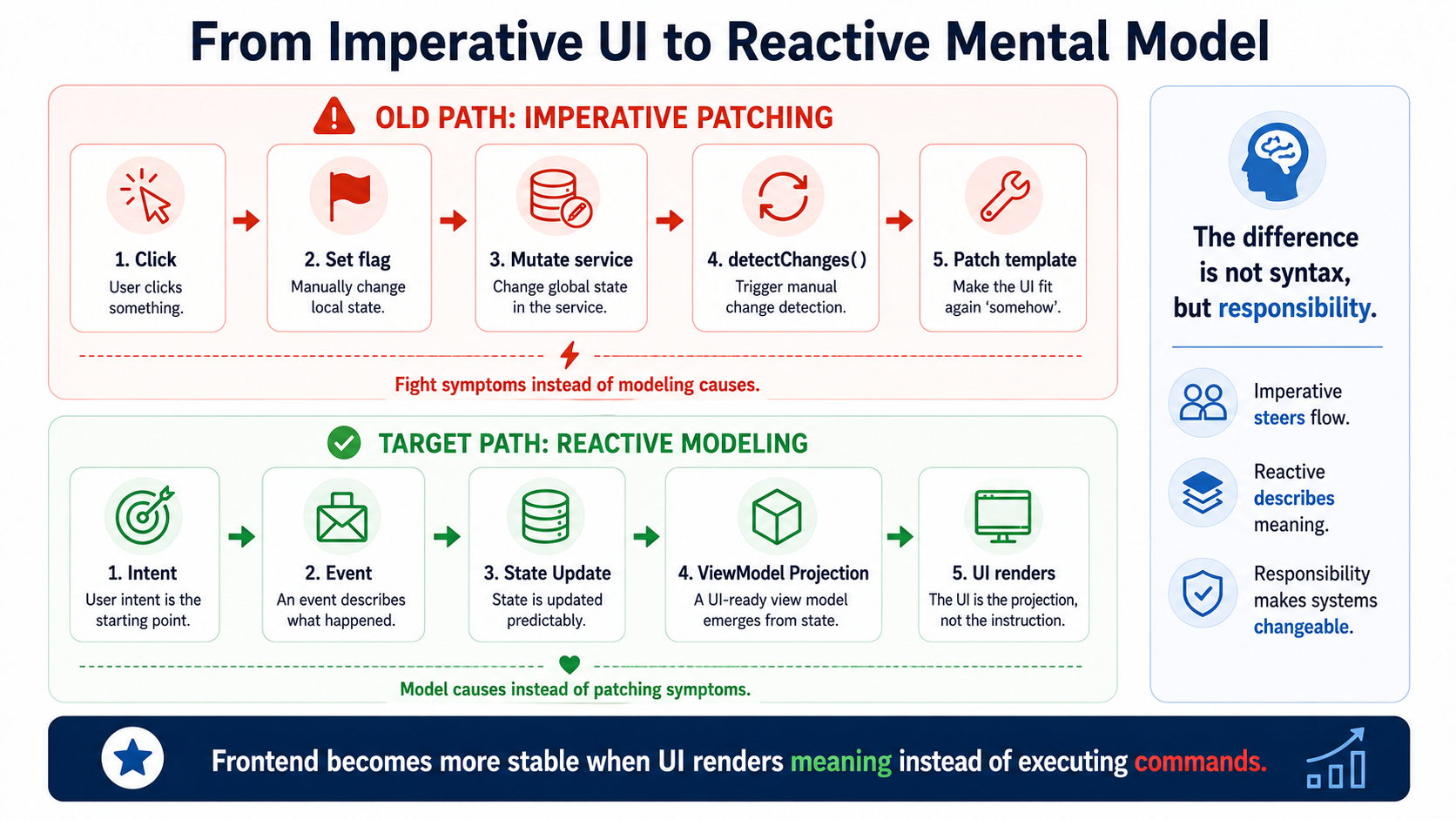
You can muddle through with setTimeout, manual change detection, global services, local flags, and subscriptions scattered everywhere.
The application runs.
Mostly.
On your own machine.
On the happy path.
With good Wi-Fi.
As long as nobody clicks too fast.
The problem isn’t that developers are dumb. The problem is that they’re speaking a language that isn’t really native to the system they’re working in.
Frontend gets underestimated
Section titled “Frontend gets underestimated”Many organizations still treat frontend like surface decoration.
As the visible edge of the system. As the last layer. As something you build after the “real” logic is done.
Typical lines:
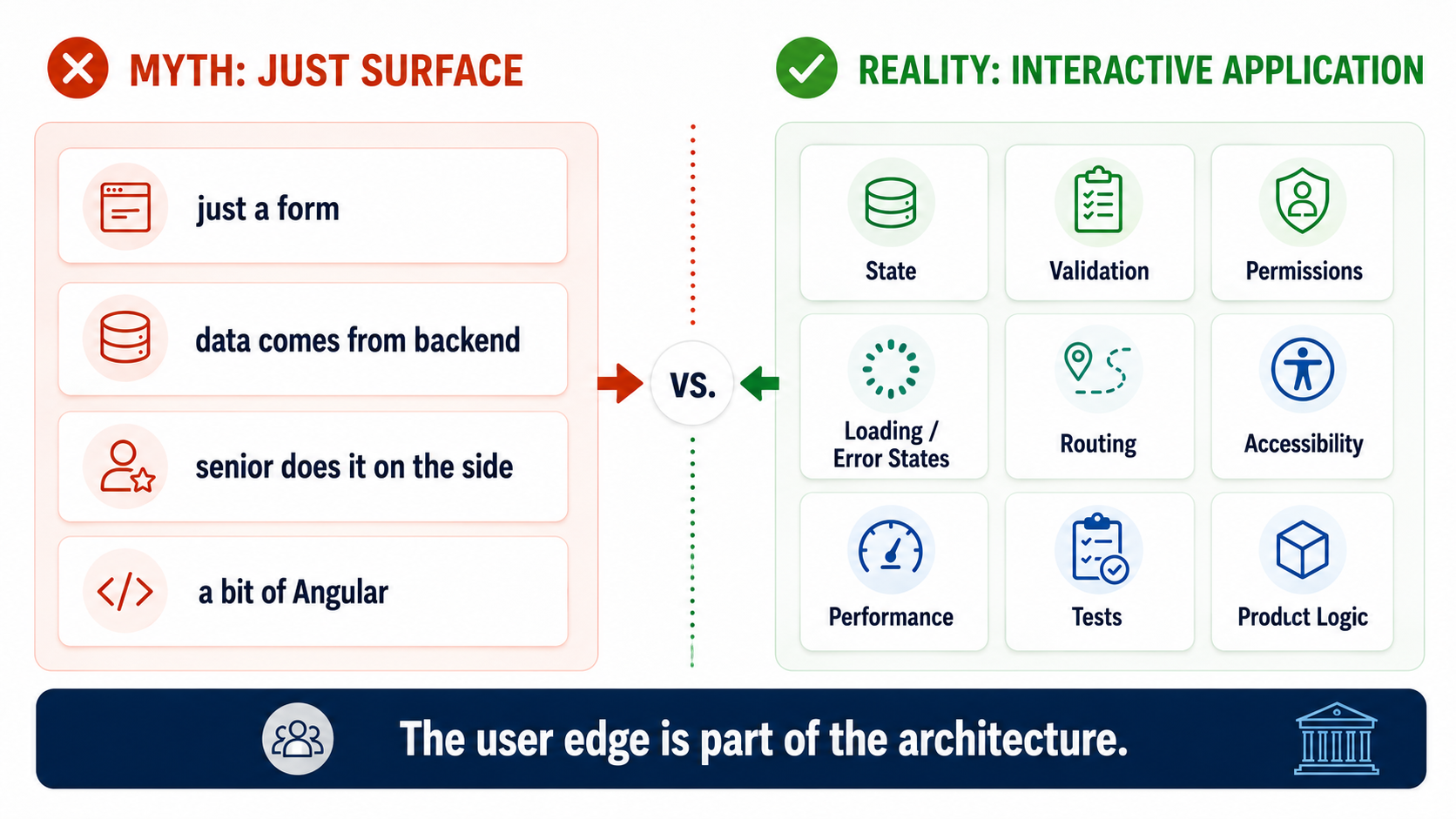
“It’s just UI.”
“The data comes from the backend anyway.”
“You can pick up a bit of React or Angular on the side.”
“The senior can handle it.”
“It’s just a form.”
These lines sound harmless.
They aren’t.
Because a whole application is often hiding behind “just UI.”
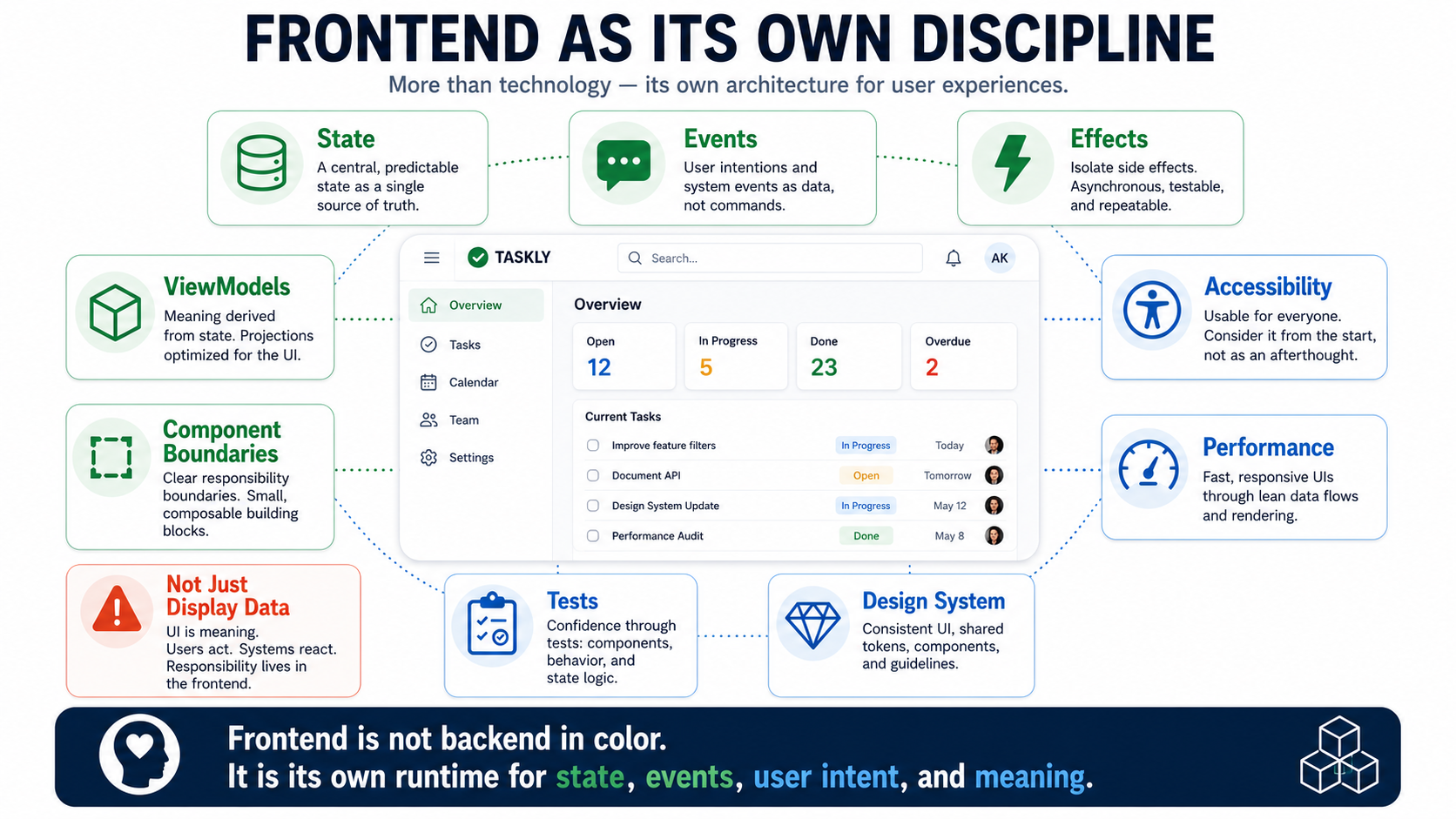
A modern frontend contains state. Validation. Permissions. Loading states. Error states. Side effects. Routing. UI flows. Caching. Real-time updates. Accessibility. Performance. Design systems. Tests. Product logic at the point where users actually touch the system.
And above all, it contains one hard truth:
The user doesn’t interact with your database.
They interact with your frontend.
If state is broken there, if flows become incomprehensible, if error messages are missing, if buttons fire twice, or if permissions are only half-modeled, then the product is broken.
Not “just the surface.”
The product.
Imperative training meets reactive reality
Section titled “Imperative training meets reactive reality”A lot of developers are heavily trained in imperative models.
That’s not wrong. On the contrary — for a lot of problems, this way of thinking is excellent.
An object has state. A method changes state. A process is controlled step by step. The calling code controls what happens next.
That’s clear. Understandable. Easy to test, if you do it cleanly.
A lot of backend systems can be sensibly modeled this way: request comes in, run the use case, open a transaction, change data, send back a response.
Frontend frameworks work differently, though.
There, the UI is often a projection of state.
Not: “I’m telling the button to look different now.” Instead: “The state changes, and the UI follows from that.”
Not: “I steer every change manually.” Instead: “Events change state, derived models describe meaning, rendering reacts to it.”
Not: “I call commands one after another until the screen looks right.” Instead: “I model data flow, side effects, and state transitions.”
That sounds subtle.
It isn’t, though.
It’s the difference between a sequence of commands and a reactive system.
Warning signs in the code
Section titled “Warning signs in the code”You can often spot the friction in small, offhand sentences.
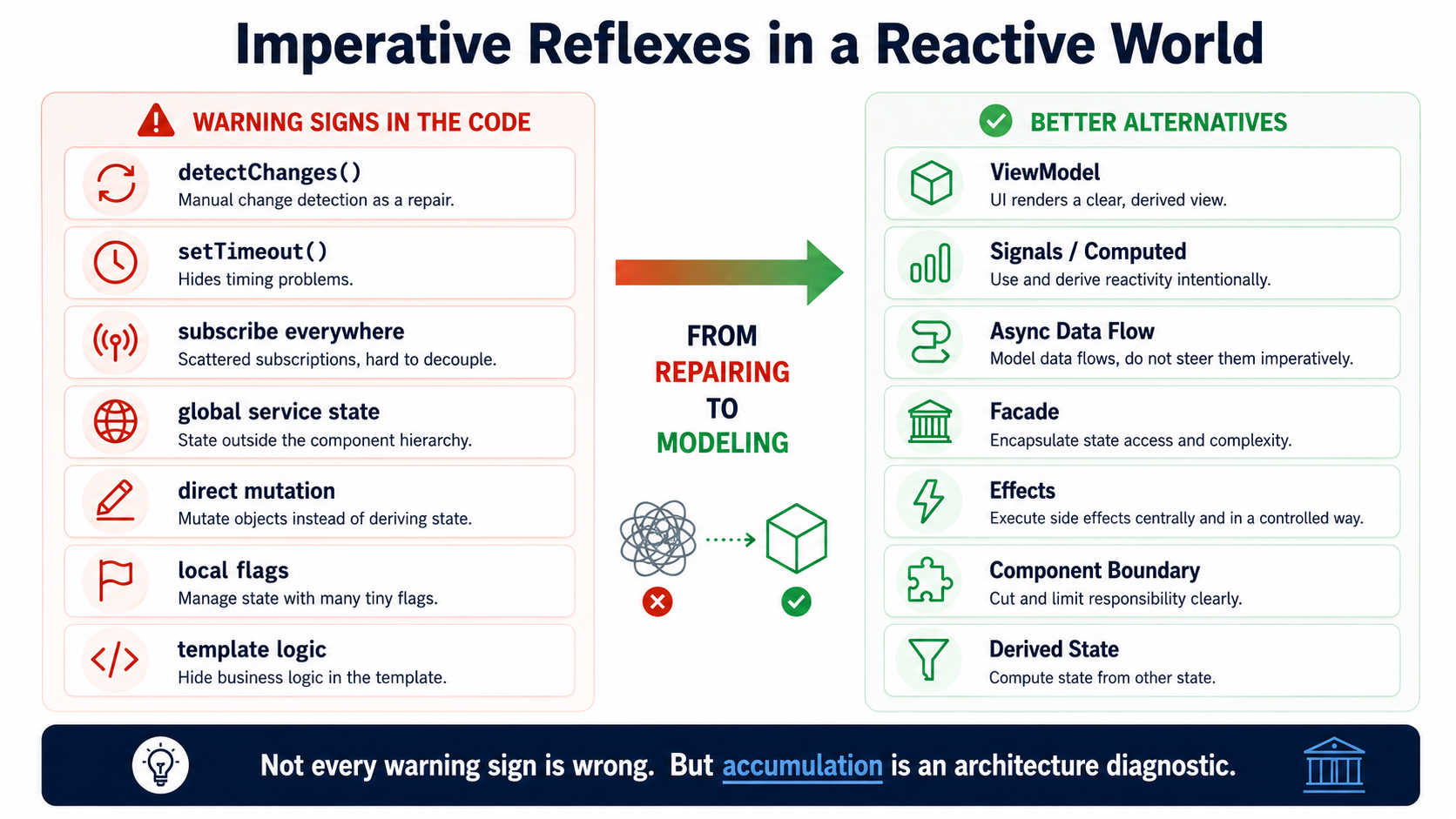
None of them is the end of the world on its own. Each one can be justified in certain situations. But when they keep showing up, architecture should clear its throat.
“I’ll just set a flag here.”
“I’ll call
detectChanges()afterward.”
“I’ll just subscribe here.”
“I’ll store the state in the service.”
“I’ll just mutate the object directly.”
“I need
setTimeout, otherwise it won’t render.”
“The component will figure out what to do.”
These aren’t moral failings.
They’re warning signs.
They usually show that the mental model doesn’t fit. Instead of deriving state cleanly, behavior gets manually patched in afterward. Instead of modeling data flow, effects get scattered around. Instead of understanding the UI as a projection, the screen gets bent into shape one step at a time.
That’s how you get frontends that work but don’t hold up.
They’re made of local flags, global service state, manual subscriptions, lifecycle tricks, template logic, and components moonlighting as process managers.
That feels fast at first.
Later, it feels like a room full of light switches where nobody remembers which one starts the coffee machine.
Why this creates friction
Section titled “Why this creates friction”Imperative code wants control.
Reactive UI architecture wants derivation.
That’s the core conflict.
In the imperative model, you ask:
What do I need to run right now to make the screen look right?
In the reactive model, you ask:
What state describes the situation, and how does the UI follow from it?
The first leads quickly to commands.
The second leads to models.
And that’s exactly where architecture gets decided.
A submit button shouldn’t be disabled just because someone set buttonDisabled = true somewhere at the right moment.
It should be disabled because the current view state says:
- a request is in flight
- the user isn’t allowed to submit twice
- the data isn’t valid yet
- or the current use case isn’t available
That’s not cosmetics. That’s meaning.
An error message shouldn’t show up at random because a catch block somewhere in a component set a local flag.
It should be part of a state model.
A screen shouldn’t have to know which API DTOs get loaded in which order.
It should render a ViewModel that’s already been translated for the UI.
When that translation is missing, the component turns into a dumping ground for unresolved architecture decisions.
And yes: it gets big.
Of course it gets big.
Suddenly it has to load data, interpret errors, check permissions, map state, open dialogs, control forms, trigger navigation, coordinate side effects, and render HTML on the side.
That’s not a component anymore.
That’s an underpaid use-case manager with CSS duties.
Education provides fundamentals — but rarely production frontend architecture
Section titled “Education provides fundamentals — but rarely production frontend architecture”A lot of degree programs and universities teach heavily toward OOP, imperative programming, algorithms, data structures, and backend-adjacent models.
That’s not wrong.
These fundamentals matter. Anyone who doesn’t understand data structures, control flow, abstraction, and modularization won’t build stable architecture in frontend either.
But it’s incomplete.
In the classic German computer-science and engineering context especially, object-oriented thinking tends to be very present:
- classes
- inheritance
- interfaces
- methods
- state mutation
- control flow
- encapsulation
- layers
That’s easy to teach. Easy to test students on. Historically established. Didactically convenient.
You can assign exercises. You can draw class diagrams. You can have students implement methods. You can write exams about it.
Reactive UI architecture is harder to grade cleanly.
How do you grade good state design? How do you test whether the architecture actually reflects the product? How do you teach UX states? How do you explain asynchronous data flow that stays maintainable for years? How do you grade component responsibility? How do you test understanding of accessibility? How do you teach design systems without just quizzing people on CSS rules?
A lot of degree programs deliver important fundamentals.
But they rarely prepare anyone to keep complex production frontends easy to change over time.
That’s not a criticism.
It’s only a problem when organizations act as if that gap doesn’t exist.
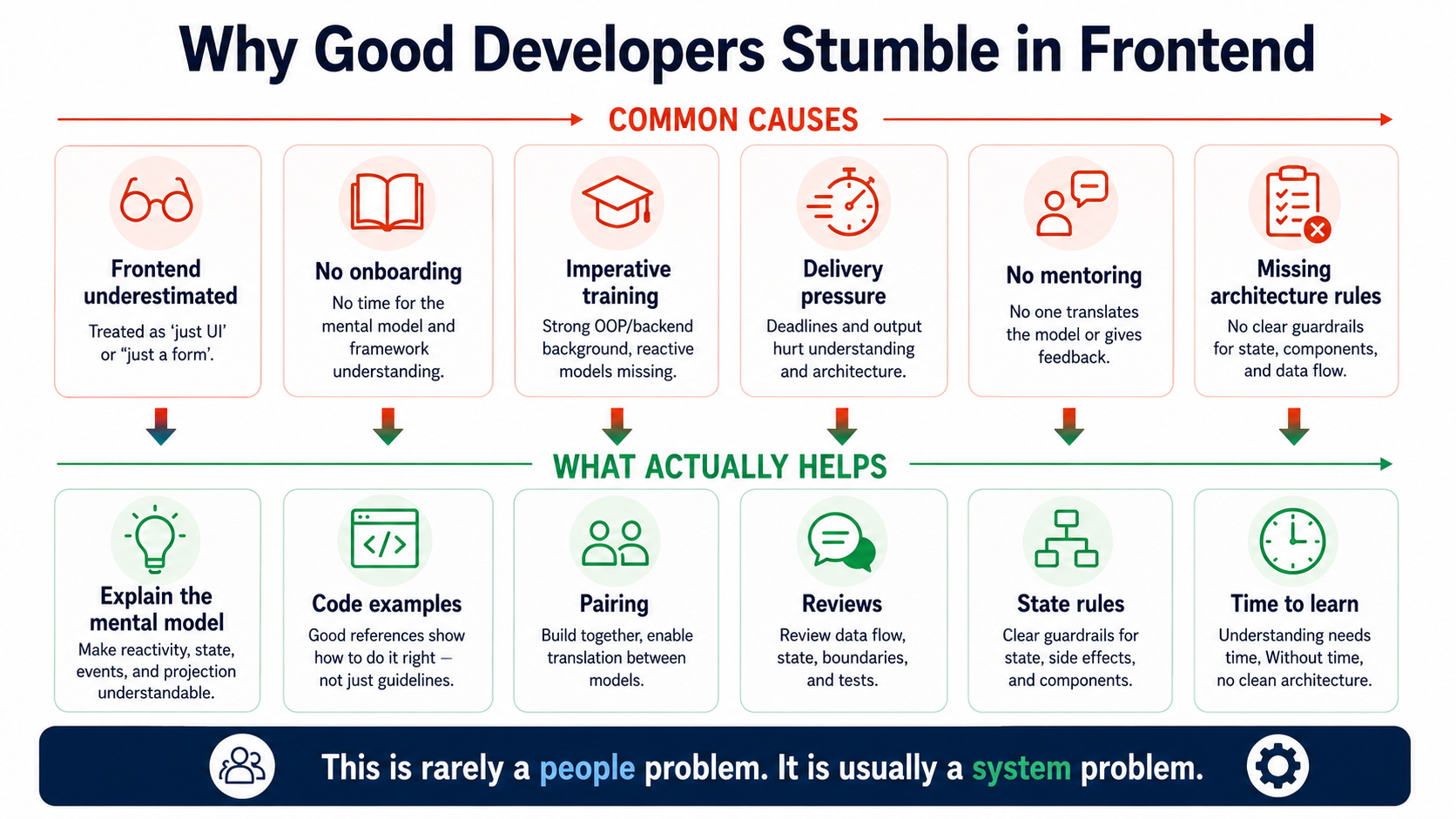
Without mentoring, you get rough-and-ready code
Section titled “Without mentoring, you get rough-and-ready code”The main problem isn’t technical.
It’s organizational.
Developers get put on frontend work without time to learn the mental model.
There are no frontend guidelines. No architecture examples. No pairing. No review culture for UI state, component responsibility, data flow, and tests. No shared language for intents, events, projections, ViewModels, side effects, and boundaries.
There’s only delivery pressure.
And then people are surprised that the solutions look rough-and-ready.
But what are developers supposed to do?
They reach for tools they know. For patterns that have worked before. For control, when the system feels foreign. For local flags, when there’s no ViewModel. For global service state, when there’s no state strategy. For detectChanges(), when nobody has explained why the rendering doesn’t match the data flow right now.
That’s rarely a people problem.
It’s mostly a system problem.
Management sees capacity — but overlooks the shift in skill set
Section titled “Management sees capacity — but overlooks the shift in skill set”From a management point of view, this often looks simple.
There’s a team. There are developers. There’s work. So you distribute the work.
Backend is fully staffed, frontend needs help, someone has seen TypeScript before.
Good fit.
Except “can program” isn’t the same as “can build production frontend architecture.”
Nobody would say:
“We have frontend developers — they can just build us a distributed transaction system real quick.”
Or:
“The Angular people can handle the database sharding for a bit.”
Or:
“You can pick up a bit of OAuth, eventual consistency, and tenant isolation on the side.”
With frontend, exactly that happens constantly.
And the consequences are predictable:
Product quality suffers. The system gets harder to change. UI bugs pile up. Tests get hard. Accessibility gets forgotten. Performance becomes a matter of chance. Frameworks get fought instead of used. Business logic ends up in the template. Developers get frustrated.
That’s not an individual failure.
That’s a planning failure.
Anyone who treats frontend as a cheap, readily available add-on skill ends up paying later in slower, riskier changes, declining delivery capability, and UI code everyone is afraid to touch.
Backend strengths are valuable — once you translate them
Section titled “Backend strengths are valuable — once you translate them”The fair view matters here:
Backend experience isn’t a disadvantage in frontend work.
On the contrary.
A lot of backend developers bring exactly the discipline that frontends badly need.
They think in models. They understand interfaces. They know failure cases. They know tests aren’t decoration. They have a feel for data quality. They know side effects can turn dangerous. They understand integration.
That’s valuable.
But these strengths have to be translated into the frontend model.
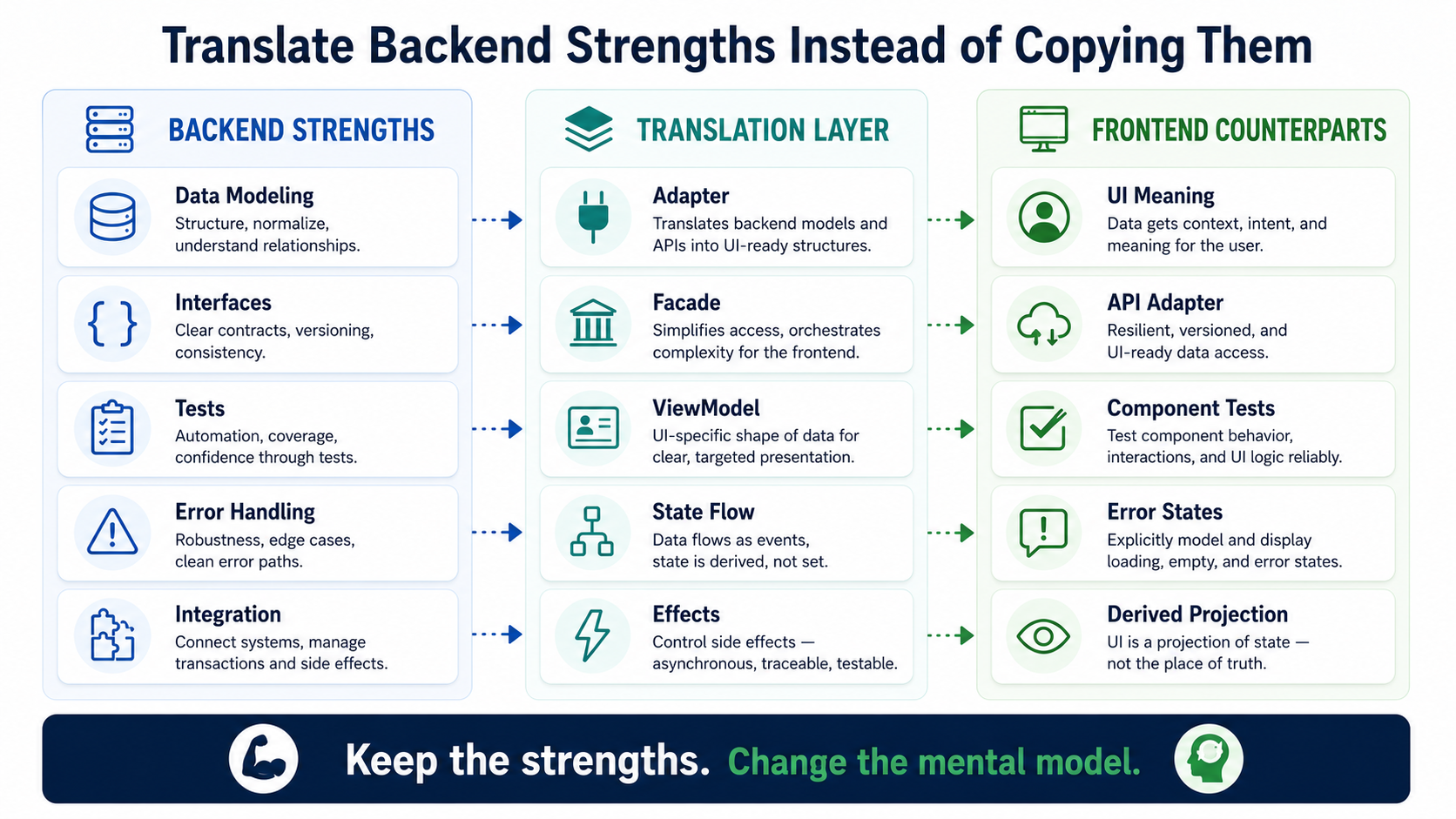
Data modeling doesn’t turn into “dump the DTO straight into the template” — it turns into a ViewModel that expresses UI meaning.
Understanding interfaces doesn’t turn into “the component knows the API response” — it turns into an adapter that shields external models.
Error handling doesn’t turn into “console.error and a toast” — it turns into an explicit UI error state.
Testing discipline doesn’t turn into just service unit tests — it turns into component tests, flow tests, contract tests, and targeted coverage of critical user paths.
Integration thinking doesn’t turn into one global service mutating everything — it turns into a controlled state flow with clear side effects.
That’s the bridge.
Not copying.
Translating.
What a better organization does differently
Section titled “What a better organization does differently”The alternative isn’t keeping backend developers away from frontend.
That would be nonsense.
The better alternative is taking frontend seriously.
Building production frontends takes more than knowing the syntax.
Frontend engineering needs explicit onboarding into the reactive mental model. Not three wiki links and a “you’ll figure it out.”
It needs clear architecture rules:
- Where does UI state come from?
- Where does API data get translated?
- What is a component allowed to decide?
- Which logic belongs in facades, stores, or ViewModels?
- How are side effects controlled?
- How do we test critical flows?
- When is local state okay?
- When do you need derived state?
- Which data is allowed into the template?
It needs good examples in the code.
Not just abstract guidelines nobody reads, but real reference spots: a clean loading state, a clean error state, a clean form flow, a clean adapter, a clean component test.
It needs pairing between frontend-oriented and backend-oriented developers.
Not as condescending tutoring, but as translation work between two strong perspectives.
It needs reviews that don’t just ask:
“Does it work?”
But also:
“Is the data flow understandable?”
“Is the state derived, or manually synchronized?”
“Is the component still a component?”
“Are side effects visible?”
“Can this be tested?”
“Are we fighting the framework, or using it?”
And it needs time.
This point is unpopular but decisive.
Anyone who doesn’t schedule time for understanding is scheduling misunderstandings instead.
Frontend has its own language
Section titled “Frontend has its own language”Good frontend architecture needs shared terms.
Not because terms sound nice and academic.
But because otherwise teams can’t talk about architecture at all.
A handful of terms is often enough to avoid a lot of chaos:
Intent What does the user or the system want to trigger?
Event What happened?
State What business or technical situation exists right now?
Projection What view follows from state and rules?
ViewModel What meaning does the UI need in order to render?
Component boundary What responsibility does a component have — and explicitly not have?
Side effect What action changes the world outside the current computation?
This vocabulary especially helps developers coming from other areas.
Because it doesn’t say: “Forget everything you know.”
It says: “Your strengths are welcome. But they get applied differently in frontend architecture.”
Not everyone has to become a frontend specialist
Section titled “Not everyone has to become a frontend specialist”Not every developer on the team has to be a deep frontend specialist.
Not everyone has to recite rendering strategies, accessibility pitfalls, browser APIs, Signals, RxJS, hydration, component testing, and design-system tokens in their sleep.
But building production frontends requires at least a baseline understanding of the model.
Otherwise you get solutions that are technically possible but architecturally expensive.
A form is no longer just a form.
It’s a small state machine with validation, permissions, loading states, error handling, side effects, and user feedback.
A button is not just a button.
It’s an entry point into a use case.
A component is not just a file with a template.
It’s a boundary.
A ViewModel is not just an object.
It’s the translation from data to meaning.
And a frontend is not the colorful edge of the backend.
It’s the runtime where user intent meets system state.
The real mistake
Section titled “The real mistake”The real mistake isn’t letting backend developers work on frontend.
The mistake is pretending no shift in mental model is needed.
Good developers can learn this shift.
Often very well, even.
But not by shouting instructions across the room. Not under constant stress. Not without examples. Not without reviews. Not without an architecture conversation.
When organizations take frontend seriously, everyone benefits:
Backend-oriented developers understand better how their APIs get used. Frontend-oriented developers get more structural support. Teams talk more clearly about state, errors, and user flows. Products get more robust. Tests get more meaningful. Changes get less risky.
And eventually even the reflex to sedate every rendering problem with setTimeout disappears.
A small win for humanity.
The better attitude
Section titled “The better attitude”The better attitude isn’t:
“Backend people can’t do frontend.”
The better attitude is:
“Frontend is its own discipline. Anyone coming from a different discipline needs translation, time, and good architecture examples.”
That’s fairer.
And a lot more productive.
Because good software doesn’t come from throwing people into unfamiliar mental models and hoping seniority handles the rest.
Good software happens when teams understand what problem they’re actually solving right now.
In the backend. In the frontend. And at the boundary between them.
The takeaway
Section titled “The takeaway”Frontend isn’t backend with a coat of paint.
It’s its own runtime for state, events, user intent, and meaning.
Anyone who treats frontend like backend doesn’t get a simple surface.
They get an imperative simulation of a reactive application.