Ubiquitous language isn't a DDD decoration
At first, ubiquitous language sounds like one of those terms you need in DDD talks so the slides look like architecture.
It isn’t, though.
Ubiquitous language is one of the most important protective mechanisms in software projects. Against misunderstandings. Against wrong models. Against broken APIs. Against UI copy that promises something different than what the code does. And against bugs that aren’t really technical bugs at all, but linguistic accidents with a deployment pipeline.
The idea is simple:
A team needs a shared language for the domain it works on.
Not just any project language. Not a few terms in the wiki. Not “the business calls it one thing, IT calls it another, but we all know what’s meant.”
Instead, a language that deliberately connects domain experts, product, development, testing, UI, API, and code.
That’s ubiquitous language.
Why language is so central to DDD
Section titled “Why language is so central to DDD”Domain-driven design isn’t primarily about patterns.
Not about aggregates. Not about repositories. Not about value objects. Not about whatever tactical building blocks you throw into a project to make it look more grown-up.
DDD begins with the domain.
That is, with the problem space. With the business logic. With the rules, terms, workflows, exceptions, and meanings a system is supposed to represent.
And that’s exactly where language becomes decisive.
Because how are you supposed to build a good domain model if it isn’t even clear what the domain terms are called? How are you supposed to draw boundaries if a term means different things across three teams? How are you supposed to keep APIs stable if nobody can clearly say what an object represents in business terms?
A model doesn’t first come into being in the code.
A model comes into being in language.
Code is later just its very precise, very unforgiving form.
If the language is fuzzy, the model gets fuzzy. If the model is fuzzy, the code will eventually make that brutally honest.
Ubiquitous doesn’t mean every word stays identical everywhere
Section titled “Ubiquitous doesn’t mean every word stays identical everywhere”One misunderstanding up front: ubiquitous language doesn’t mean the exact same words have to appear everywhere.
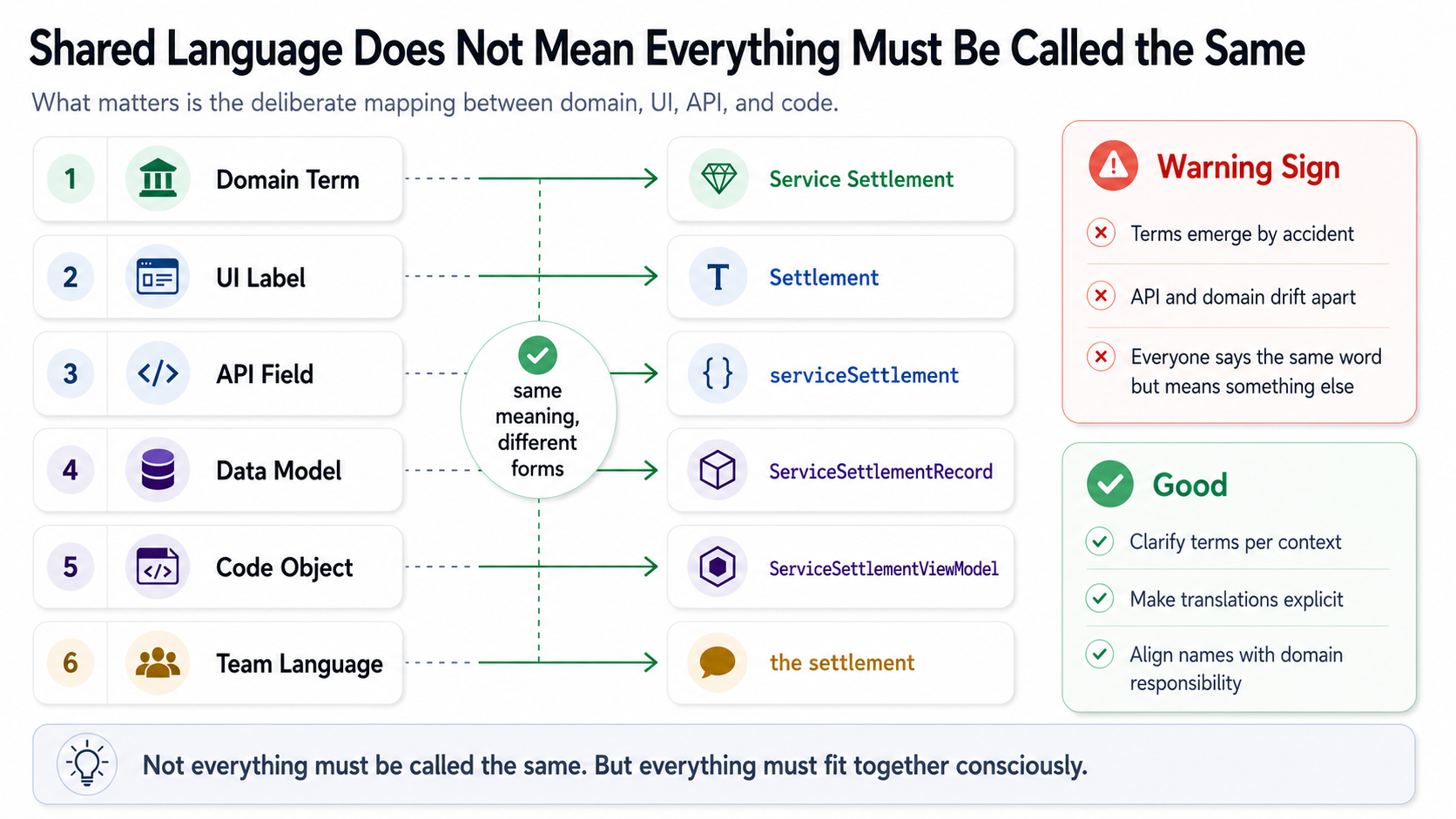
A UI label is allowed to be more user-friendly than an internal domain term. An API field is allowed to have a more technical name than a button. A data model has different constraints than a user interface. And everyday language on a team is sometimes shorter than a clean domain term.
That’s not automatically wrong.
It becomes wrong when these differences happen by accident.
When the customer uses one term, the product owner a second, the backend a third, the frontend a fourth, and the database a fifth — and everyone acts like that’s just a matter of taste.
It isn’t.
At that point, it’s no longer clear whether different names mean the same concept. Or whether the same name means different concepts. Both are dangerous.
Ubiquitous language doesn’t mean linguistic uniformity, then. It means deliberate mapping.
It has to be clear:
- What’s the domain term?
- How does it show up in the UI?
- What’s it called in the API contract?
- What’s it called in the code?
- In which context does this meaning apply?
- Where does translation happen?
- And where must translation never happen silently?
If that mapping isn’t clear, you don’t get a flexible system. You get semantic fog with autocomplete.
The thing with “Statement”
Section titled “The thing with “Statement””I once got pulled into a bug discussion.
On the call were a frontend developer, a backend developer, an external customer, internal stakeholders, a product owner, and eventually me as the architect. The meeting had everything: a bug, six opinions, and an object called Statement.
Everyone was talking about this Statement.
Unfortunately, nobody meant exactly the same thing.
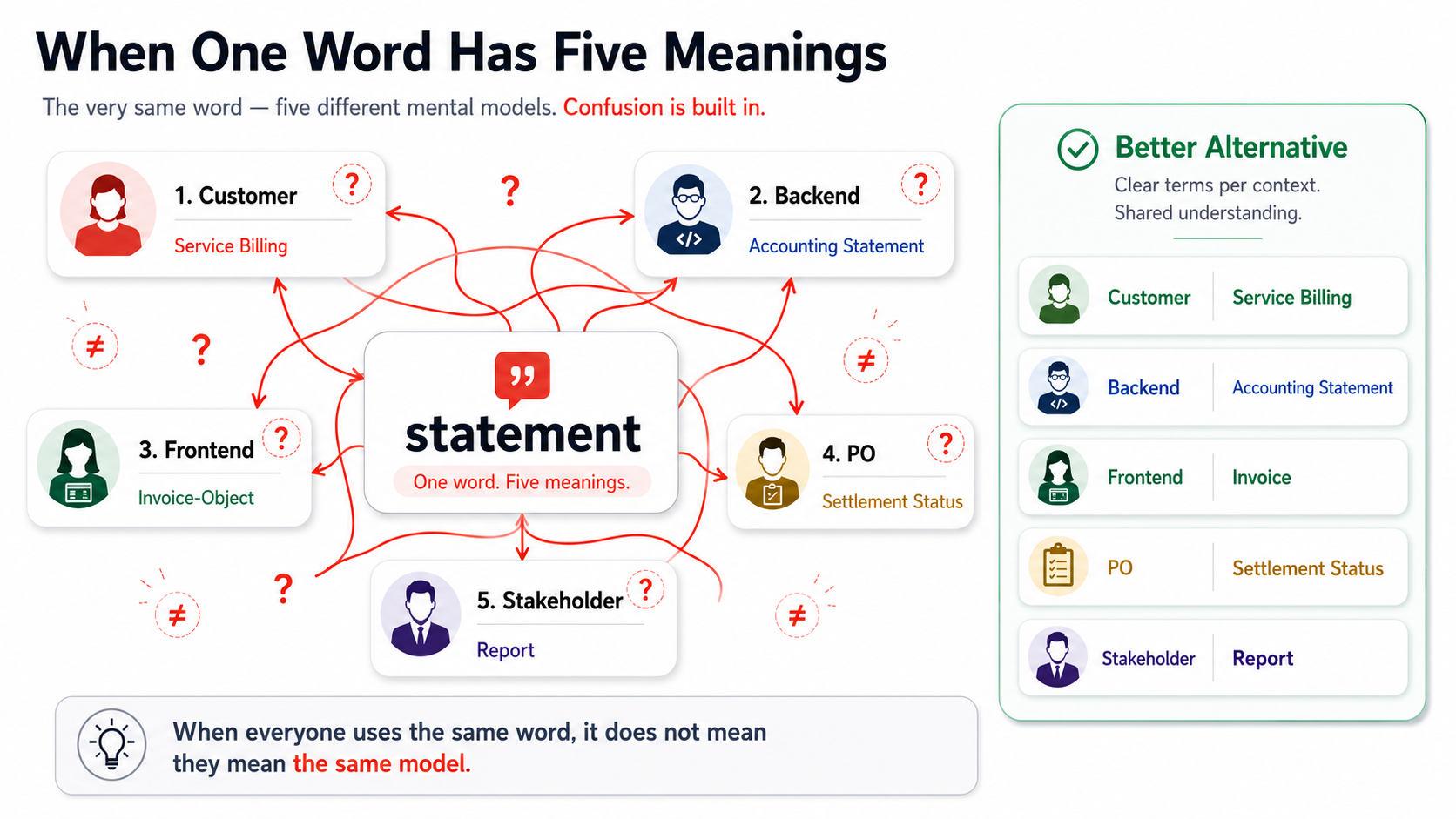
In business terms, the customer was talking about a billing statement for services rendered. In IT, that eventually turned into an accounting statement. And because people like saving time, in everyday use that just became Statement.
In parallel, the frontend had modeled an actual bill somewhere else. So something that, in business terms, was more of an invoice. But that object was also called statement.
Probably because it looked similar. Or because a statement already existed somewhere. Or because “that’s just how it grew historically.” One of those sentences where you just know: there’s an old architecture accident buried under the laminate somewhere.
The result:
The customer meant a billing statement for services rendered. The backend meant an accounting statement. The frontend meant a bill. The PO was thinking of a process state. Some stakeholders were thinking of a report.
Everyone was talking about the same word.
Unfortunately, not about the same thing.
And that’s exactly the point.
The problem wasn’t that Statement was an English name. English isn’t evil. German doesn’t save any architecture either. The problem was that the word no longer represented a clear domain concept.
It had become a container for multiple meanings.
When a term can mean anything, it can no longer reliably mean anything in the code.
That wasn’t a naming problem
Section titled “That wasn’t a naming problem”You could now say: “Okay, so just rename it cleanly.”
Yes. That too.
But that falls short.
A wrong name is often just the visible symptom of a deeper problem — namely, that the team doesn’t have a shared domain model.
A name isn’t just cosmetics. A name carries assumptions.
If an object is called Invoice, I expect a bill.
If it’s called Statement, I expect some kind of account summary, declaration, or billing document.
If it’s called BillingReport, I expect a report.
If it’s called Settlement, I expect a reconciliation or a payout process.
These expectations shape how developers write code. How testers phrase test cases. How product owners describe acceptance criteria. How stakeholders understand requirements. How users interpret the interface.
Names are architecture.
Not because pretty names look elegant. But because names draw boundaries. Express responsibility. Stabilize meaning. Or blur it.
Being too lazy to name things properly is not an architecture principle.
Why this hurts especially in the frontend
Section titled “Why this hurts especially in the frontend”In the frontend, broken language becomes visible fast.
The frontend sits right between the user, the product, design, the backend, and the API. It has to represent domain concepts and behavior, guide input, explain states, translate errors, and often bring several technical models together into one understandable ViewModel.
When the domain language is unclear, the frontend turns into a translation office for modeling failures.
Then the API field is called statement, the UI shows “bill,” the domain experts call it “billing statement for services rendered,” the form says “proof of billing,” and in the code there’s a StatementViewModel that means something different depending on the route.
You can technically build all of that.
You can also wallpaper a house with a damp basement.
The only question is how long you want to keep pretending the wallpaper is the problem.
Frontend architecture especially needs clean language for exactly this reason. Not because frontend sounds “close to the business,” but because that’s where it becomes obvious when the product model, user understanding, and technical interfaces don’t fit together.
Bounded contexts make differences visible
Section titled “Bounded contexts make differences visible”Of course, a term is allowed to be used differently in different contexts.
An Account in the identity context isn’t necessarily the same as an Account in the accounting context. A Statement in banking can be something different than a Statement in a billing context. A Customer in a CRM isn’t automatically the same model as a Customer in support or in invoicing.
That’s okay.
But then the boundary has to be visible.
That’s exactly why bounded contexts matter so much. Not as an architecture buzzword, but as a protective fence around meaning.
Within one context, a term should be precise. Across context boundaries, translation is allowed. But that translation has to happen deliberately.
Not secretly through a DTO that gets passed everywhere.
Not through a shared model that’s supposedly neutral and in truth just centralizes all the fuzziness.
Not through an object called Statement that means everything, so nobody has to decide.
If a term has different meanings in different contexts, that’s not a problem.
If nobody knows which context they’re currently talking in, it is.
Warning signs of broken language
Section titled “Warning signs of broken language”A handful of sentences should immediately grab attention on any project:
- “That’s just what we’ve historically called it.”
- “The customer calls it something else.”
- “It’s called something different in the frontend than in the backend.”
- “It’s actually a bill, but in the code it’s called Statement.”
- “It’s hard to explain, but everyone knows what’s meant.”
- “It’s kind of a catch-all object.”
- “The field gets interpreted differently depending on the case.”
- “Technically it’s the same thing, but not quite in business terms.”
- “We’ll translate that properly later.”
- “Everyone knows what’s meant.”
That last sentence is especially dangerous.
“Everyone knows what’s meant” often just means: everyone has learned to live with the same fuzziness.
That’s not shared understanding. That’s collective resignation with a sprint goal.
What you can actually do
Section titled “What you can actually do”Ubiquitous language doesn’t have to start with a big DDD workshop.
Often it’s enough to slow down at the right moments.
Especially in heated bug discussions, you shouldn’t jump straight into logs, JSON payloads, or who’s-to-blame. Clarify first:
Are we actually talking about the same thing right now?
For an object called Statement, good questions would have been:
Statement of what? For whom? In which process? What business responsibility does this object have? Is it a bill? A billing statement for services rendered? A report? A status? A document? A piece of booking information?
If that produces several different answers, you’ve found something valuable: not the bug, but the cause behind an entire class of bugs.
In practice, a few simple rules help:
Define terms per context. Don’t water down domain terms out of convenience. Name code objects after their business responsibility. Don’t fill API contracts with vague catch-all terms. When translating, check whether the meaning survives. Deliberately map UI labels onto domain terms. Keep glossaries lightweight, but alive. And if a term has several meanings: model it explicitly instead of continuing to talk around it.
The goal isn’t language policing.
The goal is to make the shared understanding of the domain stable enough to build software from.
Shared language is architecture work
Section titled “Shared language is architecture work”Ubiquitous language isn’t a decorative DDD term.
It’s the connection between the domain and the code. Between the customer and the team. Between product decisions and implementation. Between what’s meant and what gets built.
When that connection breaks, you don’t get small cosmetic flaws. You get wrong models, wrong APIs, wrong interfaces, and bugs nobody understands right away, because everyone has different pictures in their head for the same words.
That’s why language is architecture work.
Not the pretty kind of architecture work with diagrams and arrows. More the uncomfortable kind, where you ask in a meeting:
“Wait. What exactly do we mean by Statement?”
And suddenly it goes quiet.
That’s usually a good sign.
The takeaway
Section titled “The takeaway”Just because everyone uses the same word doesn’t mean they share the same model.
Ubiquitous language doesn’t begin in the glossary. It begins the moment someone asks:
Are we actually talking about the same thing right now?