How Do You Migrate to Microfrontends—and When Do You Stop?
“Nothing meaningful can be extracted from this legacy system anymore.”
“We will simply extract every area as a remote, one by one.”
Both statements are too absolute.
Independent capabilities can be created even in a tightly entangled system. That does not necessarily mean that complete units are already waiting to be separated technically. Domain boundaries often have to be made visible first, dependencies reduced, and responsibilities reorganized. What is described as extraction may in fact be decoupling—or even reconstruction.
Conversely, the technical ability to build and integrate one part of the frontend separately does not yet create a viable MFE strategy. An additional deployable can just as easily introduce new pipelines, contracts, and operational responsibilities without removing a single meaningful source of waiting time.
The central question is therefore not whether an existing frontend can technically be split into remotes:
Which concrete problem should be solved through more independent paths of change?
A microfrontend migration does not begin with the first remote. It begins with an honest assessment of the existing system, its risks, its domain boundaries, and its actual need for autonomy.
Microfrontends Are Not a Modernization Goal
Section titled “Microfrontends Are Not a Modernization Goal”Microfrontends are neither a required maturity level for large frontends nor the automatic target state of legacy modernization. Modernizing a legacy frontend describes a goal. Microfrontends are only one of several possible paths toward it.
Modernization may mean strengthening internal module boundaries, improving tests and build processes, defining domain responsibilities more clearly within a monolith, or building a new modular monolith. Individual product areas can be reconstructed. In particularly entangled areas, a partial or complete rewrite may be the more honest description. Selectively extracting capabilities as microfrontends is another option—not the predetermined final stage.
A stable starting point can be entirely legitimate:
stable monolith├── few developers├── shared priorities├── short coordination paths├── reliable releases├── manageable tests└── clear responsibilityA distributed landscape introduces additional requirements:
microfrontend landscape├── integration contracts├── multiple deployables├── additional pipelines├── distributed diagnostics├── platform governance└── greater local operational responsibilityThose costs can be justified when they replace real coordination costs. If distribution removes no meaningful waiting time, release coupling, or organizational blockage, however, it lacks an economic justification.
Where the same people already decide, test, and release together, a separate deployable does not automatically create an autonomy benefit. An organization without an autonomy problem does not need an autonomy architecture. A stable monolith maintained by a small group of developers can be the right target state.
Choosing not to adopt microfrontends is therefore not a sign of insufficient technical maturity. It may be the most professional outcome of a serious assessment.
Which Problem Should Be Solved After the Migration?
Section titled “Which Problem Should Be Solved After the Migration?”Before drawing a target architecture, setting up a host, or creating the first remote, the organization should be able to complete a concrete sentence:
After the migration, Team X can change, test, and release Capability Y independently without waiting for Z.
For example:
After the migration, the billing team can release regulatory changes independently.
After the migration, the support area no longer depends on the full release of the customer portal.
After the migration, Business Unit A can operate its product area independently of Partner B.
These statements name a path of change, a responsibility, and a dependency that exists today. They can later be verified. Before the first remote is created, the current coupling should therefore be recorded—for example through the teams involved, shared approvals, or recurring waiting time.
An unsuitable target description would be:
After the migration, the frontend consists of several remotes.
The number of remotes describes the technical form. It does not describe economic value.
A frontend can consist of ten remotes and still be tested, approved, and released only as one unit. In that case, the technical structure has been distributed, but changeability has not. A new remote is not evidence of a successful migration when the old coupling merely continues through different technical connections.
If no concrete independent path of change can be named, the migration should not begin with technical extraction.
Understand the Current State Before Designing the Target Architecture
Section titled “Understand the Current State Before Designing the Target Architecture”The current-state assessment must not stop at component folders, import graphs, and build times. A viable MFE strategy connects at least five perspectives: domain, technology, organization, operations, and economics.
Domain Current State
Section titled “Domain Current State”The first question is whether recognizable capabilities exist or can plausibly be reconstructed.
Which domain rules belong together? Which areas usually change together? Which data and decisions belong to an area? Are today’s pages and components merely technical fragments, or do they express a distinct business capability? Could the area be described independently of its current UI structure?
The search for an MFE boundary does not begin at a route or component folder. It begins with domain responsibility.
A route may merely be a navigation decision. A folder may have evolved historically around technical categories. A component structure may represent shared presentation without containing an independent capability. Not every extractable surface is an independent capability.
Technical Current State
Section titled “Technical Current State”The actual dependencies are then made visible: direct imports between areas, global state, shared services, central domain logic, dependencies on the shell, shared configuration, product-wide tests, shared build and release paths, and hidden runtime coupling.
The decisive distinction is:
Which dependencies are required by the domain—and which exist only because of history?
A capability may need contracts with the rest of the product. Complete isolation is neither realistic nor desirable. Problems arise when every local change needs to understand the internal state of other areas, calls central services containing foreign domain logic, or makes sense only inside the complete product environment.
Organizational Current State
Section titled “Organizational Current State”A technical boundary has to be accompanied by sustainable responsibility. The assessment must therefore include long-lived teams, capability owners, decision rights, product responsibility, acceptance responsibility, release authority, and operational responsibility.
Frequently changing project teams and central approval boards are equally relevant. An area can be technically well separated while the organization still prevents independent change.
Architecture can make ownership visible and support it. It cannot replace ownership.
Operational Current State
Section titled “Operational Current State”A microfrontend migration changes more than source code. It affects release processes, test environments, failure diagnosis, incident responsibility, rollback capability, observability, dependencies on platform or operations teams, and manual approvals.
A team is not autonomous when it writes the code itself but has to wait for several central units to test, diagnose, and release it.
Economic Current State
Section titled “Economic Current State”Finally, the assessment must reveal where today’s coupling actually creates cost: blocked teams, coupled releases, delayed acceptance, different rates of change, missed customer commitments, or recurring priority conflicts.
The current-state analysis does not search for places where a remote can technically be inserted. It searches for paths of change that should become economically independent.
Could This Become an Independent Application?
Section titled “Could This Become an Independent Application?”A deliberately simple diagnostic question helps test suspected boundaries:
Could this domain area become a small independent application?
The purpose is not to require it to be delivered as a separate product. The question forces a more precise description of responsibility.
Which rules does the area own? Which data does it need? Which decisions does it make itself? Which platform capabilities would it have to simulate? Could it be started locally and tested independently? Which external states would it have to import? Which other teams would still be required for every change? Who would own the area end to end? Which small number of stable contracts would it need with the rest of the product?
If the supposed area needs almost the entire existing state, numerous internal services, and several external teams, there may not yet be a viable microfrontend boundary.
That does not mean migration is impossible. It means more work is required before extraction: consolidating domain rules, encapsulating state, restructuring dependencies, and clarifying ownership.
The Risks of Migration, Inaction, and the Halfway State
Section titled “The Risks of Migration, Inaction, and the Halfway State”A serious decision does not consider only the risk of migration. It compares three different risk states.
Risks of Migration
Section titled “Risks of Migration”A microfrontend migration creates additional platform and integration costs. Old and new paths may temporarily exist in parallel. Adapters, transitional contracts, and duplicate tests require maintenance. New ownership may remain unclear, skills may be missing, and available feature capacity often falls during the migration.
Poorly chosen boundaries are especially expensive. They create numerous contracts, duplicate domain logic, or move coupling into global events, shell services, and product-wide test chains. Inconsistent behavior between old and new areas and overly long parallel structures are also real risks.
Risks of the Existing State
Section titled “Risks of the Existing State”The existing state is not automatically free or low-risk. Release coupling can increase, tests can become slower and less reliable, knowledge can concentrate in a few people, and broad dependencies can block modernization. Waiting time, change risk, and difficult fault analysis can reduce forecast reliability.
That does not mean every legacy system inevitably becomes more expensive over time. A stable monolith can deliver reliably for years. Risks must be observed in the actual system, not inferred from its age.
Risk of the Halfway Migration
Section titled “Risk of the Halfway Migration”The most dangerous state is often not an obvious technical failure, but a migration that remains permanently between the starting point and the target architecture:
old system+new remotes+temporary adapters+old approval processes+shared test environment+no consistent decommissioningThe greatest risk is not always that a migration fails technically. More often, it remains permanently caught between the old and new architecture.
A halfway migration can be more expensive than either clear target state because it retains the old coupling while adding technical distribution. It has multiple deployables but no local releases. It has new integration contracts but still requires product-wide acceptance. It has temporary adapters that nobody can remove.
Decommissioning must therefore be part of the migration strategy from the beginning.
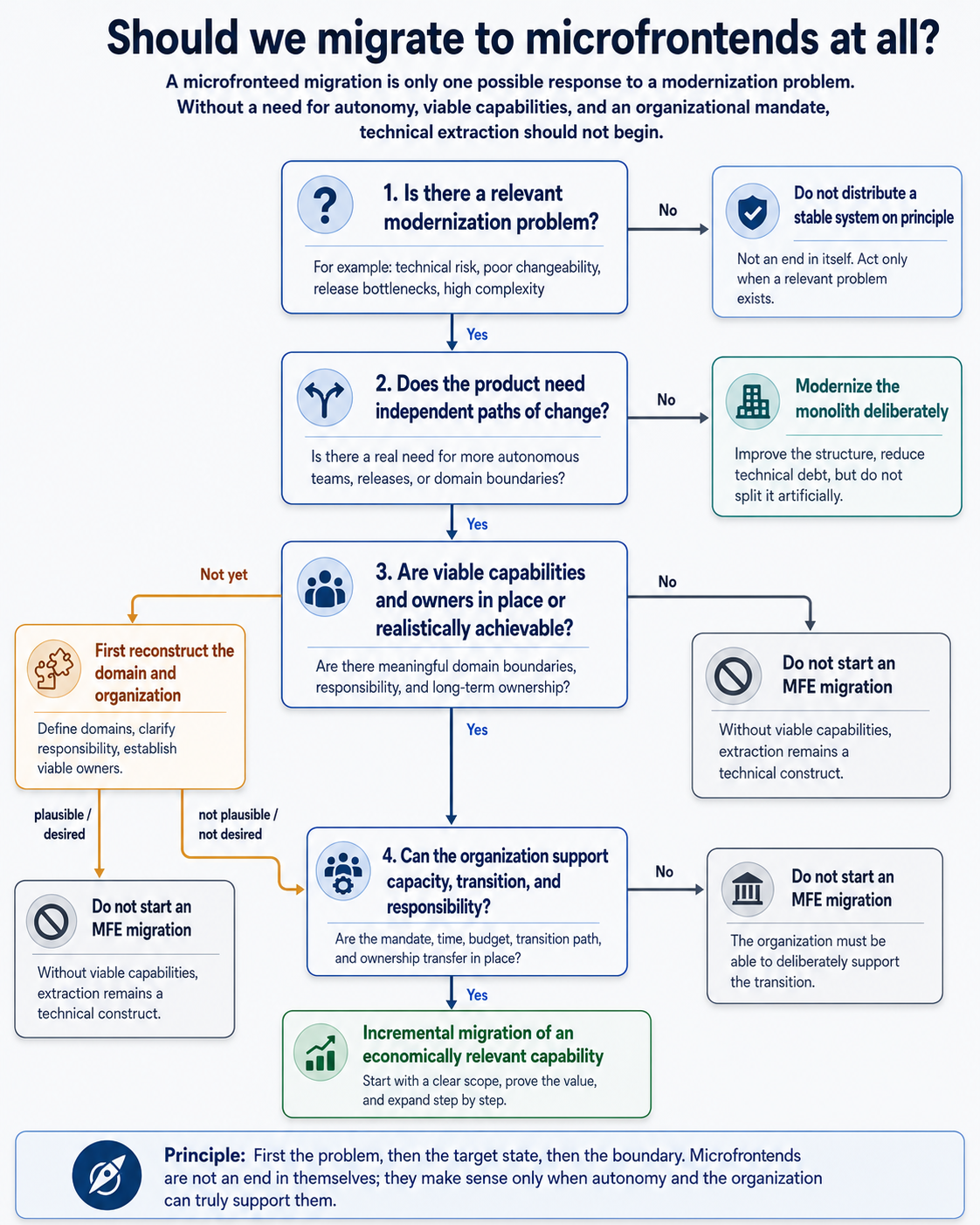
Does an MFE Strategy Fit the Organization?
Section titled “Does an MFE Strategy Fit the Organization?”This question comes before the technical extraction strategy.
An organization does not have to be perfectly organized around autonomous teams before it starts. It must, however, be willing to support the required change explicitly. A technically possible migration is not yet an organizationally viable strategy.
The assessment should ask:
- Does the product need independent paths of change?
- Do several teams work in parallel over the long term?
- Do product areas have different priorities or release cycles?
- Are there long-term capability owners?
- May those owners make local decisions?
- Can teams test their area independently and trigger releases themselves?
- Can they diagnose failures and assume operational responsibility?
- Is the platform designed for self-service?
- Can governance rules act as stable guardrails rather than case-by-case approvals?
- Do stakeholders support transitional costs and migration capacity?
A single no does not automatically rule out microfrontends. Several no answers, however, indicate that no viable strategy exists yet.
An organization that does not allow autonomy should not introduce an architecture whose economic value depends on autonomy.
Why the Migration Cannot Succeed Against the Organization
Section titled “Why the Migration Cannot Succeed Against the Organization”A serious migration requires more than technical approval:
deliberate migration├── reserved capacity├── stakeholder mandate├── transitional architecture├── changed ownership├── new test and release paths├── operational responsibility└── decommissioning of old structuresThis is often contrasted with an expectation that is internally contradictory:
desired migrationbut:├── no additional capacity├── unchanged feature velocity├── no new responsibilities├── no temporary duplication├── no independent releases└── no decommissioning effortA microfrontend migration is not a technical side task. It changes how the product is developed, tested, released, and owned. A microfrontend migration cannot be carried out incidentally or against the organization.
Stakeholders do not need to want microfrontends as a technology. They need to support the investment, the changed responsibilities, and the intended independent path of change.
If the organization does not want to support that change, it should not begin an MFE migration. This is not an accusation. It is a strategic decision against costs and responsibilities whose benefit could not be realized under the current conditions.
Three Possible Outcomes of the Initial Assessment
Section titled “Three Possible Outcomes of the Initial Assessment”A good initial assessment does not necessarily end with a remote. It can produce three different outcomes.
1. No MFE Migration Required
Section titled “1. No MFE Migration Required”stable monolith+few developers+clear responsibility+reliable releases+low coordination costsIn this case, it may be sensible to keep the monolith, strengthen internal module boundaries, improve tests, and modernize the technology without distributed deployments.
Sometimes a good microfrontend assessment ends before the first remote exists.
That is not failure. It prevents an architecture whose ongoing costs would not create corresponding value.
2. Prepare the Domain and Technology First
Section titled “2. Prepare the Domain and Technology First”autonomy would be valuablebut:├── domain boundaries are unclear├── ownership is missing├── state is global├── tests are product-wide└── dependencies are too broadExtracting a remote would be premature. Capability boundaries must first be reconstructed, ownership clarified, data access encapsulated, direct dependencies reduced, local testability established, and platform contracts defined.
This preparation is already part of the migration. It does not yet create another deployable, but it ensures that a later remote becomes more than a technical shell.
3. Incremental MFE Migration
Section titled “3. Incremental MFE Migration”recognizable capability+long-term owner+real need for autonomy+containable dependencies+independent test and release pathExtraction is plausible here. Technical feasibility is only one prerequisite. The autonomy benefit provides the justification.
Extraction, Decoupling, or Reconstruction
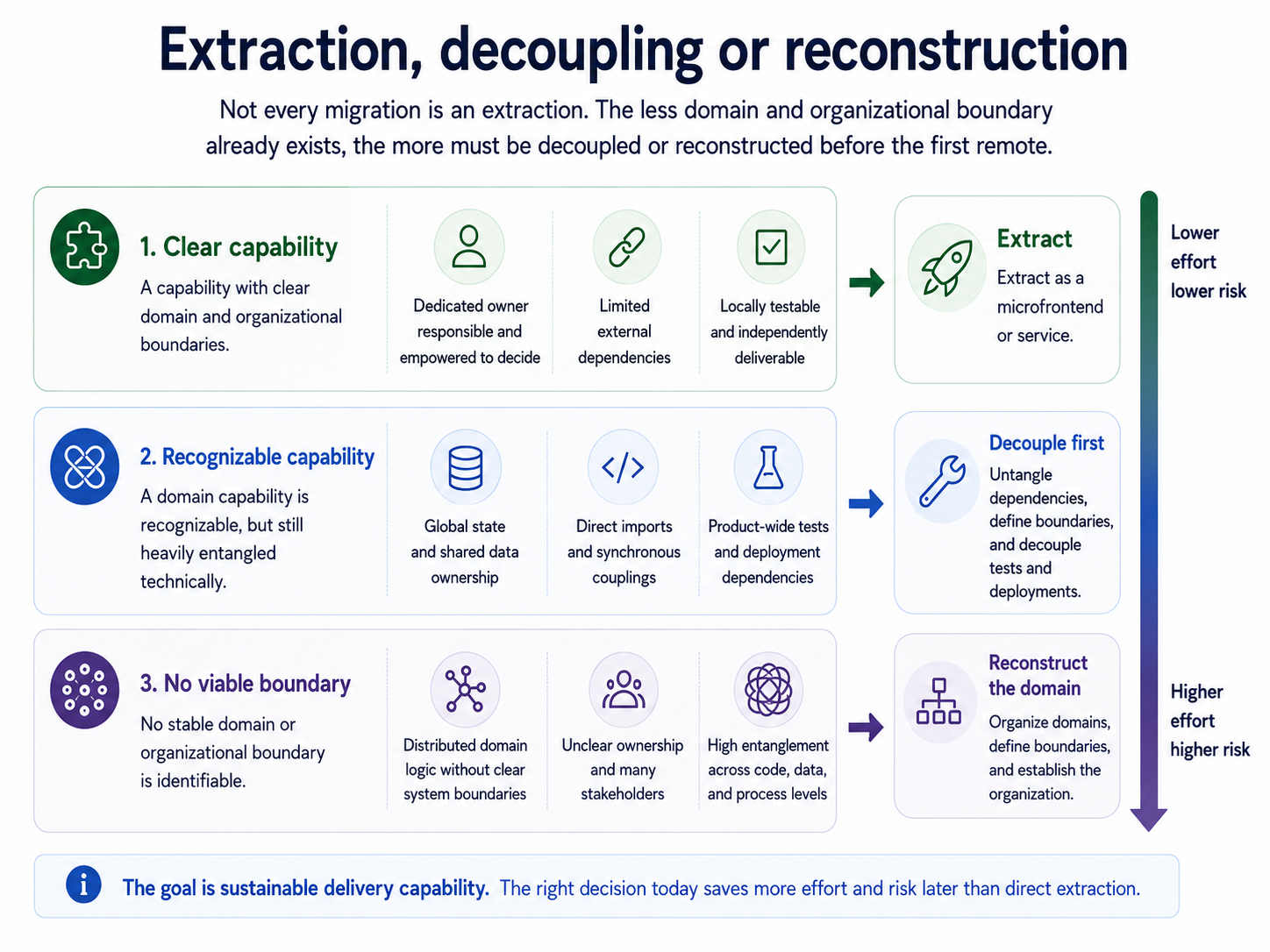
Section titled “Extraction, Decoupling, or Reconstruction”Not every microfrontend migration begins from the same starting point. The distinction between extraction, decoupling, and reconstruction is therefore central.
Extraction
Section titled “Extraction”A largely self-contained unit already exists:
Capability├── own rules├── clear owner├── limited dependencies├── understandable data needs└── locally testable behaviorThe existing code can be separated incrementally. Integration contracts become explicit, build and delivery are separated, and the old path can be removed after the transition.
This is the most favorable case, but it is not the default in every legacy system.
Decoupling Before Extraction
Section titled “Decoupling Before Extraction”The domain capability is recognizable but technically entangled:
recognizable capabilitybut:├── global state├── direct imports├── shared services├── central navigation└── product-wide acceptanceThe migration does not begin with the remote. It begins by reducing coupling. Domain access is encapsulated, dependencies are turned into explicit contracts, and local tests become possible.
Technical extraction gains value only once the capability can be operated and validated meaningfully outside the complete product.
Reconstruction
Section titled “Reconstruction”Sometimes no viable unit exists:
domain rules distributed across the system+unclear ownership+no local acceptance+historically grown state+almost every change affects several areasThe capability must then be modelled again and may have to be largely reimplemented. In heavily entangled areas, reconstruction may effectively amount to a partial or complete rewrite.
Extraction moves an existing unit. Reconstruction creates a unit that did not previously exist.
The less domain and organizational separation already exists, the greater the effort, risk, and required migration capacity.
Choose the Most Valuable Cut, Not the Easiest One
Section titled “Choose the Most Valuable Cut, Not the Easiest One”The first candidate is often selected because a particular screen is technically easy to extract. This reduces initial risk, but it may answer the wrong question.
A suitable candidate should ideally have recognizable domain responsibility, a long-term owner, real current coupling, frequent change, a containable integration contract, locally testable behavior, and an expected autonomy benefit.
Technically isolated but domain-neutral pages, general layout, central navigation, component libraries, or rarely changed edge areas without a current bottleneck are not automatically suitable. Areas that still require the complete product and several other teams for every change are poor candidates as well.
An easy cut is not automatically a valuable cut.
A technically simple page can serve as a platform proof. It shows that build, deployment, and runtime integration work. It does not yet prove the economic value of the MFE strategy. The first meaningful success occurs where a capability can actually be changed, tested, and released more independently afterward.
Migration Is Product Work, Not a Side Task
Section titled “Migration Is Product Work, Not a Side Task”A microfrontend migration can be described as a directed loop:
- Define the intended benefit.
- Identify the capability and owner.
- Make existing dependencies visible.
- Stabilize the domain and technical boundary.
- Define the integration contract.
- Enable local testing and delivery.
- Move functionality incrementally.
- Remove the old path and temporary adapters.
- Evaluate the autonomy benefit.
- Deliberately decide on the next extraction.
Every extraction should not merely create something new. It should make part of the old system obsolete.
New capabilities can be built alongside the existing system and old paths replaced incrementally. Such directed transitions are often described with the Strangler Fig pattern. The relevant point here is not the migration pattern itself, but that every new path demonstrably makes an old one unnecessary.
Transitional Architecture Needs Direction and Decommissioning
Section titled “Transitional Architecture Needs Direction and Decommissioning”During the migration, old and new navigation may coexist. Temporary adapters, parallel API variants, old and new state models, broader shared tests, or a host integrating both worlds can be legitimate.
A viable transitional architecture has clear properties:
transition├── clear purpose├── known owner├── limited scope├── observable use├── replacement criterion└── planned decommissioningA transitional architecture is not a failure. A permanently directionless transitional architecture is.
A temporary adapter is part of a migration only when its removal is planned. A parallel path needs a replacement criterion. A broad integration test may be temporarily necessary, but it should not silently become the new permanent approval authority.
Decommissioning is therefore not cleanup after the real migration. It is a success criterion of the migration.
A Remote Without Independent Acceptance Is Not a Migration Target
Section titled “A Remote Without Independent Acceptance Is Not a Migration Target”A new remote is not a meaningful target if it can be validated only inside the complete product.
The capability should be runnable locally, work with simulated platform contracts, and support domain acceptance without the full product environment. Targeted composition tests remain necessary in the host. They verify integration, but they do not repeat the complete domain validation of every participating area.
The capability must also be releasable independently, and its exact version must be diagnosable when failures occur.
A remote that is built separately but can only be tested and approved product-wide has not escaped the old release coupling.
Ownership is therefore more than code responsibility. It includes domain responsibility, tests, local release, observability, and incident responsibility. The owner should not be identified only after technical extraction.
A project team that is dissolved after the migration is not a long-term capability owner. A central architecture group can prepare boundaries, develop integration contracts, and provide platform capabilities. It cannot own the product area permanently.
Where nobody wants to own a capability for the long term, no independent remote should be created.
Distribution should not become more granular than the organization can sustain responsibility for over time.
Reassess the Benefit After Every Capability
Section titled “Reassess the Benefit After Every Capability”After every major extraction, the MFE strategy has to demonstrate again that further distribution remains economically sensible.
The assessment should ask:
- Can the team release independently more often?
- Does a local change require fewer other teams?
- Is independent acceptance possible?
- Have product-wide tests become more targeted?
- Were old paths removed?
- Were temporary adapters decommissioned?
- Are incidents easier to assign?
- Is ownership easier to understand?
- Is the release path shorter or more reliable?
- Did the expected autonomy benefit actually appear?
Universal target values are not necessary. What matters is whether the originally identified problem has become demonstrably smaller.
A migration should prove after every capability that further distribution remains economically sensible.
The first successful extraction is not an automatic approval for all others. Every new boundary needs its own justification.
Why Not Everything Has to Become a Remote
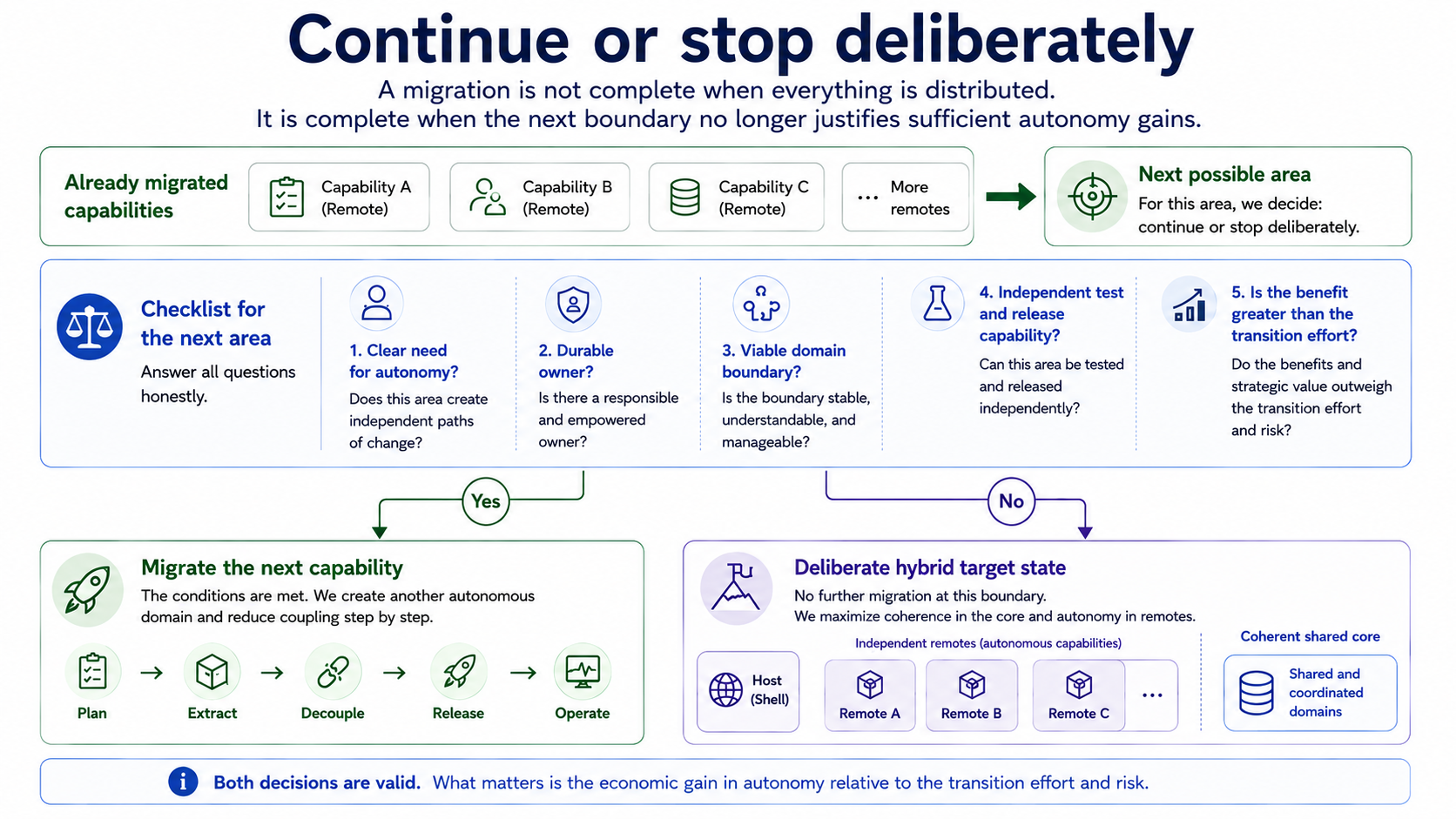
Section titled “Why Not Everything Has to Become a Remote”A successful microfrontend migration does not have to end in a fully distributed landscape.
A sensible target state may look like this:
Product├── host and platform├── Capability A as a remote├── Capability B as a remote├── Capability C as a remote├── coherent shared core└── deliberately shared functionsThat is not an unfinished state.
A shared core can be coherent in domain terms, changed by the same people, and have no relevant need for autonomy. Deliberately shared functions do not have to be distributed artificially merely because remotes exist elsewhere.
A deliberate hybrid target architecture is not a failed intermediate state. It can distribute precisely those boundaries where different rates of change, owners, and release paths create value, while leaving the remaining core shared.
When the Next Extraction No Longer Creates Value
Section titled “When the Next Extraction No Longer Creates Value”Stop signals do not appear only when extraction becomes technically impossible.
The next area may lack a long-term owner. There may be no meaningful need for independent change. The area may almost always change together with other areas. Its domain entanglement may be greater than the possible autonomy benefit.
A boundary that creates many new contracts but removes little waiting time is also a warning sign. The same applies when only a technical boundary exists, but no domain boundary; when the organization cannot sustain the additional operational responsibility; or when transition effort exceeds expected value.
It is particularly problematic to argue that the next extraction must happen simply because other remotes already exist. Previous decisions do not replace a new assessment.
You do not stop only when nothing can be extracted technically. You stop when the next boundary no longer creates a defensible domain, organizational, or economic autonomy benefit.
The Deliberate Decision to Stop
Section titled “The Deliberate Decision to Stop”A microfrontend migration can still be sensible when the existing system has no clean technical modules today. The fewer domain boundaries, ownership structures, and local testing capabilities already exist, however, the less the work resembles extraction and the more it becomes decoupling or reconstruction.
Microfrontends are a sensible modernization path only when the product needs independent paths of change and the organization is prepared to support the required responsibility, decision rights, testability, release capability, transitional capacity, and decommissioning.
Where a stable monolith maintained by a small group of developers delivers reliably, there may be no autonomy problem. In that case, choosing not to adopt microfrontends may be the better economic and architectural decision.
The current-state assessment comes before the target architecture. Migration risks must not be compared with an allegedly free status quo. The existing state—and especially the halfway state—has risks of its own.
Not every technically extractable surface is a capability. Every extraction needs a concrete benefit, a long-term owner, independent acceptance, and a decommissioning path. An organization that does not want to use autonomy should not introduce an autonomy architecture.
The target state may remain hybrid. Choosing not to make the next extraction is part of a good migration strategy. Microfrontends are not an end in themselves.
A good migration strategy does not prove that everything can be distributed. It first asks whether distribution solves a problem at all—and stops as soon as the next boundary creates more effort than autonomy.