How Do You Validate Independent Frontend Releases?
A Green Component Pipeline Does Not Prove the Product Works
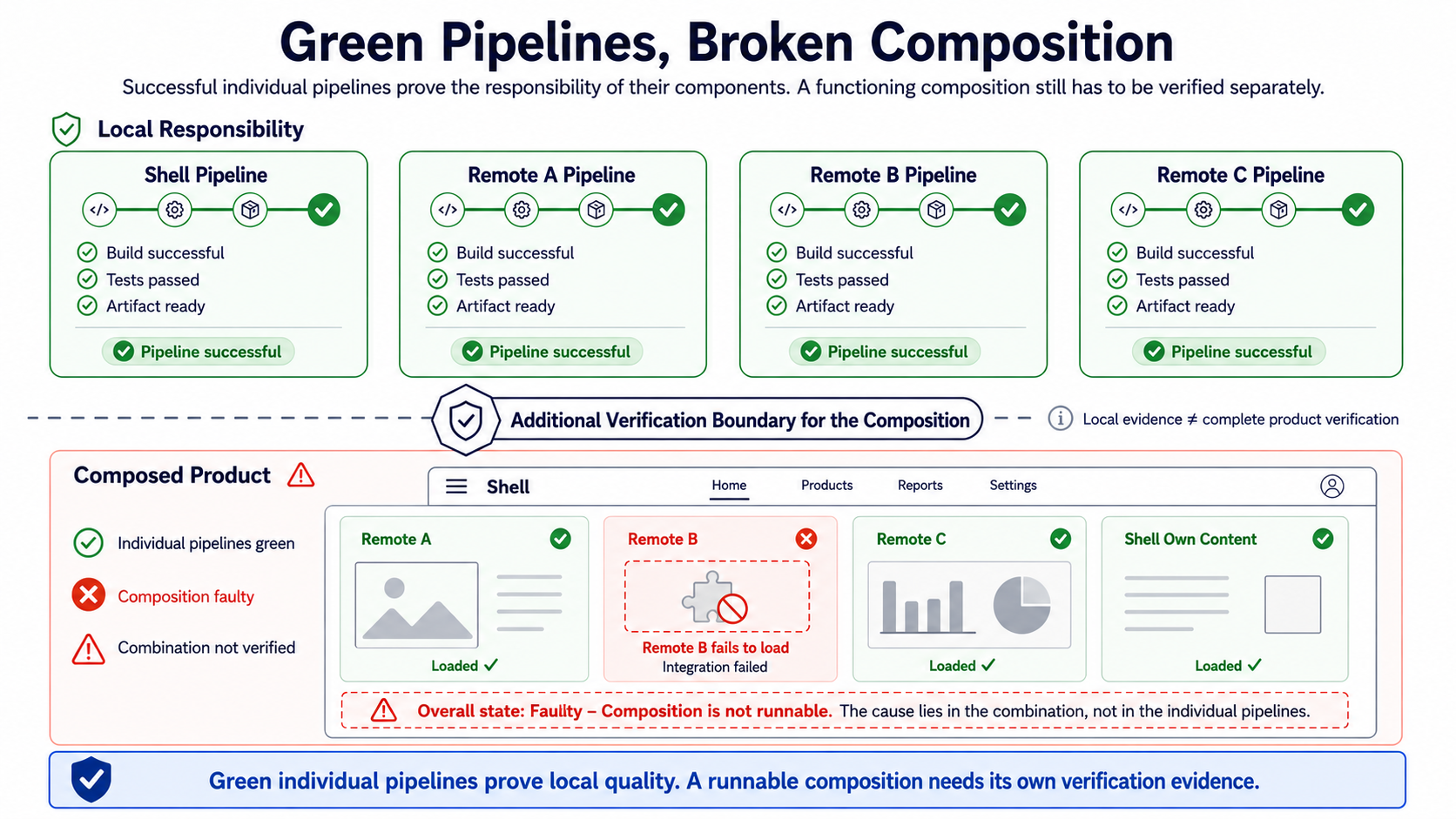
Section titled “A Green Component Pipeline Does Not Prove the Product Works”Shell Pipeline ✅Remote A Pipeline ✅Remote B Pipeline ✅Remote C Pipeline ✅
Product ❌At first, this state appears contradictory. Every participating pipeline is green, yet the composed application is unusable. Perhaps a remote cannot be loaded. Perhaps the shell provides a different authentication context than expected. Perhaps mounting works, but unmounting leaves global state behind. Perhaps the artifact was built correctly but is not reachable at its published address.
That does not make the green component pipelines worthless. Each of them merely made a limited claim. The shell verified its responsibility. The remotes verified theirs. What remained unanswered was whether those parts actually work together in the combination being delivered.
The obvious counterreaction would be to validate every change again in the complete system. Every remote release would then have to pass through a central environment, a long end-to-end pipeline, and a shared approval. The artifacts would remain technically separate. Organizationally and operationally, the architecture would be coupled again.
The decisive question is therefore not whether testing should be local or integrated. It is:
Which responsibility should be demonstrated in which validation environment?
An independently releasable remote needs its own realistic validation environment. How extensive that environment must be depends on the responsibility and risk of the release. Depending on the test objective, it may use stubs, real backends, ephemeral systems, or an independently runnable domain slice. A targeted smoke test against the shell version intended for the release then verifies the composition.
Independent releases need independent validation — but not isolated self-confidence.
Independent Delivery Requires Independent Validation
Section titled “Independent Delivery Requires Independent Validation”A remote is not independent merely because its pipeline produces a separate artifact. That artifact may be versioned, built, and published independently. The independence becomes practically meaningful only when the responsible team can also evaluate the release candidate on its own.
The team must be able to start the candidate, use it realistically, test it automatically, and validate it from a domain or visual perspective. It must be able to provide defined dependencies or connect to them deliberately. Most importantly, that evaluation must not inherently require the complete product to be running.
Validation here does not mean only a manual approval. It means a traceable evaluation of the concrete release candidate through automated tests, domain review, visual inspection, or a combination of those methods.
A separate artifact without its own validation environment can be delivered independently, but it cannot be verified independently.
That does not mean a remote has to run in complete isolation. An independent validation environment may use a real backend, an identity provider, or other shared services. What matters is that the team can provision that environment itself or use it reliably for its release without depending on a central product-wide approval.
Such an environment may be significantly smaller than the complete product. It still has to represent the responsibility of the release realistically enough. An environment whose simplifications hide the relevant risks does not create credible independence. Nor is a complete product landscape automatically the better test environment when only a clearly bounded remote risk has to be assessed.
Test Scope Should Follow Risk Reach
Section titled “Test Scope Should Follow Risk Reach”For independently released remotes, a traditional classification into unit, integration, and end-to-end tests is not sufficient on its own. More important is the reach of the risk that a test is meant to cover.
local implementation risk└── unit and component tests
remote domain risk└── validation in a dedicated remote environment
contract risk└── contract tests and verified stubs
composition risk└── targeted smoke test in the current shell
product-wide flow└── a small number of system-wide end-to-end tests
A local validator does not require the complete product shell. A domain flow within one product area should not first be proven in a central full-system environment. A changed platform contract cannot be secured reliably through additional component tests. And a correctly tested remote may still fail in the real composition.
The size of a test should match the reach of the risk.
This does not create a rigid pyramid. It distributes responsibilities. The further a risk extends beyond its own slice, the more strongly the validation must include real integration boundaries. The more local the risk remains, the less its validation should depend on unrelated parts of the system.
The Mini-Host as the Smallest Realistic Validation Environment
Section titled “The Mini-Host as the Smallest Realistic Validation Environment”For many remotes, a mini-host is the smallest useful validation environment. It does not start the remote as an isolated collection of components, but within a controlled platform context.
Remote in Mini-Host├── own entry point├── routing├── theme and locale├── defined AuthContext├── platform adapters└── API stubs or real API connectionThe mini-host is not a copy of the product shell. It may provide the remote’s technical prerequisites—routing, theme, locale, a defined authentication context, platform adapters, controlled API access. It must not, however, recreate the real shell’s product-wide navigation, layout, global state, or domain logic. Doing so would merely produce a second shell that had to remain synchronized permanently, turning the validation environment itself into another form of coupling.
Its task is smaller. It provides the contracts and technical conditions that the remote needs in order to run. Those may include routing, theme, locale, a defined authentication context, platform adapters, and controlled API access.
Within this environment, the team can validate navigation inside the product area, loading, empty, and error states, different UI capabilities, and responsive behavior. Domain use cases, behavior when dependencies are unavailable, mounting and cleanup, and the usability of the actual release candidate belong here as well.
The mini-host simulates the platform boundary. It does not simulate the entire product.
The domain behavior is not disconnected from the real platform. It is validated against an explicit platform contract. That bounded responsibility is precisely what makes the mini-host useful: it provides enough realism for credible remote validation without tying every local check to the availability of the complete product.
A remote is only independently testable when its validation does not inherently require the full shell.
This validation still has a limit. The mini-host shows that the remote runs against the agreed platform contract. It does not show that the current production shell actually fulfills that contract in the same form. That question remains the composition’s to answer.
Stubs Need Verified Contracts
Section titled “Stubs Need Verified Contracts”Stubs are attractive for a dedicated validation environment. They provide reproducible data, defined failure states, and targeted authorization situations. They start quickly, do not compete with shared test systems, and work well for pull-request previews. Edge cases that are difficult to create in real environments can be represented deliberately.
That control can be deceptive. A stub may continue to pass every test even though the real provider has changed its contract. An additional required field, a different status code, or a changed lifecycle sequence may never appear in the local simulation.
A stub must therefore not be an invented approximation of whatever is convenient for the remote at the moment. It should be generated from a verified contract or be checked against the same contract as the real provider.
For platform contracts, that may include AuthContext, theme, locale, navigation, notifications, and mounting and lifecycle interfaces. For API contracts, it may include request and response structures, status codes, error models, required fields, and domain-relevant variants.
Remote└── expects contract
Stub└── implements the same contract
Platform or API└── proves that it fulfills the contract
Contract tests connect independent validation with real integration. Their relevant question is not whether a stub looks plausible, but whether consumer and provider still fulfill the same agreed contract.
A stub is trustworthy only when it represents the same verified contract as the real platform or API.
Contract tests do not replace domain validation. They do not determine whether a use case is understandable, complete, or correct from the domain perspective. They secure the boundary on which that validation relies.
The Remote Can Run Against Real Backends
Section titled “The Remote Can Run Against Real Backends”Independent remote validation does not automatically mean simulating every dependency. A remote can run in a mini-host or through its own entry point while using an existing development or test environment.
Remote├── mini-host or own entry point└── existing development or test environmentThis option validates actual HTTP contracts, real authentication, real data formats, and concrete error responses. Domain flows through the backend and integration with existing data and services also become visible.
Its advantage is greater realism with manageable infrastructure effort. The team does not have to provision a complete environment for every release while still communicating with real systems.
That introduces different dependencies. A shared test environment may be unstable or temporarily unavailable. Test data changes. Several teams influence one another. Certain starting states are difficult to reproduce. A failing test may therefore indicate either a defect in the release candidate or an unrelated condition in the environment.
Stubs and real systems are not quality levels. They answer different questions. Stubs are especially useful for controlled states and reproducible edge cases. Real backends provide stronger evidence about the communication that is actually operated.
Independent validation does not mean that every dependency is simulated. It means that the team can use the required validation environment independently.
Ephemeral Environments for Pull Requests
Section titled “Ephemeral Environments for Pull Requests”When neither local stubs nor shared backends provide the required degree of realism and reproducibility, an ephemeral environment may be useful. It is created for a branch or pull request and removed again afterward.
Pull Request │ ▼build release candidate │ ▼provision temporary environment │ ├── remote ├── required APIs ├── database └── necessary infrastructure │ ▼automated E2E tests and validation │ ▼remove environmentSuch an environment can combine real system components with a reproducible starting state. It avoids competition for a shared test environment and exposes exactly the release candidate produced by the pull request. Automated tests and manual validation therefore operate on the same version.
The release candidate no longer exists only as an abstract pipeline artifact. A preview link makes it accessible for domain validation, visual review, accessibility checks, responsive behavior, different test identities, and targeted error, empty, and end-to-end scenarios.
A preview does not prove that the real composition works. It validates the remote within the provisioned environment. The current product shell remains a separate integration boundary.
Ephemeral environments also have a cost. Provisioning and startup take longer. Infrastructure costs rise. Test data and dependent services have to be prepared automatically. Operational complexity grows significantly once environments must be created, observed, and removed reliably.
Whether the branch workflow resembles GitHub Flow or follows another model does not change the architecture principle. It is equally secondary whether GitHub Actions, GitLab, Azure DevOps, or another system provisions the environment. What matters is whether the additional realism justifies the risk and cost of the concrete release.
A Complete SCS as a Possible Vertical Validation Environment
Section titled “A Complete SCS as a Possible Vertical Validation Environment”In a vertically sliced Self-contained Systems architecture, the dedicated validation environment can extend beyond the remote.
Domain SCS├── remote or standalone frontend├── own APIs├── own database├── authentication integration├── storage└── additional domain infrastructureThe complete domain slice can then be started and validated independently. Depending on the domain, this may include an identity provider such as Keycloak, a database, object storage such as MinIO, a message broker, or additional domain APIs.
This form of independent validation does not arise from microfrontends alone. It requires a more extensive vertical architecture of the overall system. The team then owns not only a separate frontend artifact, but an independently operable domain slice.
A complete SCS is one possible validation environment, not the minimum requirement for every remote. For many product areas, such an environment would be unnecessarily expensive or organizationally unavailable. It is useful where responsibility, data ownership, and operation are already sliced vertically.
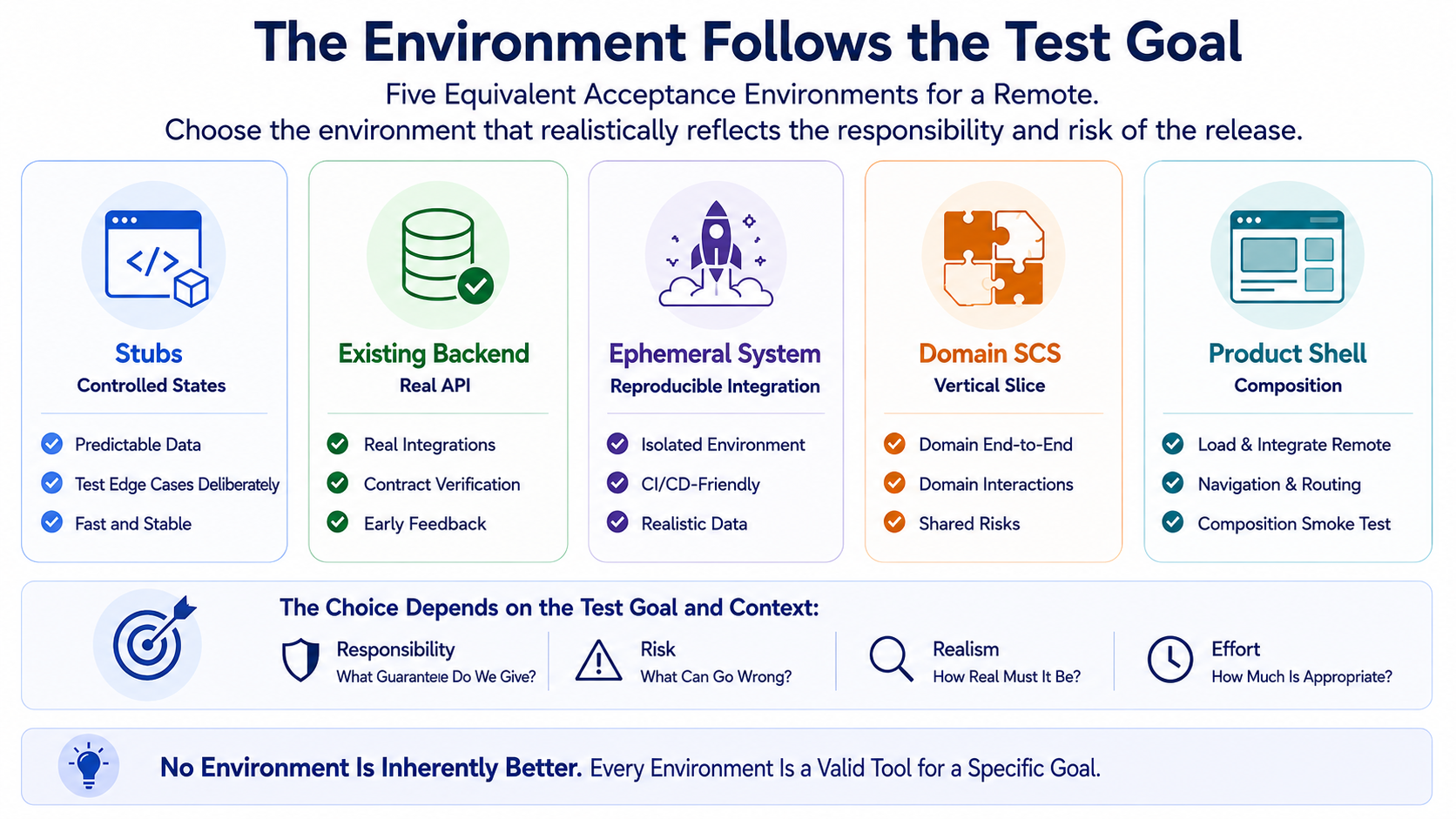
The Validation Environment Follows the Test Objective
Section titled “The Validation Environment Follows the Test Objective”The possible validation environments do not form a linear maturity ladder.
Remote + stubs└── controlled UI and state validation
Remote + existing backend└── frontend against real APIs
Remote + ephemeral vertical environment└── reproducible integration of the release candidate
fully runnable SCS└── validation of the complete domain slice
release candidate + current shell└── verification of the composition
The largest and most expensive environment is not automatically the best. A complete domain SCS may be disproportionate for a small visual defect. An invented stub may provide too little realism for a critical change to authentication behavior. A shared backend environment may be sufficient for a simple read use case but unsuitable for reproducible failure scenarios.
The selection depends on responsibility, risk reach, and the criticality of the change. Provisioning time, infrastructure cost, required realism, and reproducibility matter as well.
The validation environment should not be as large as possible. It should represent the responsibility and risk of the release realistically.
Testing as small as possible does not mean testing in artificial isolation.
Domain Behavior Is Validated in the Dedicated Environment
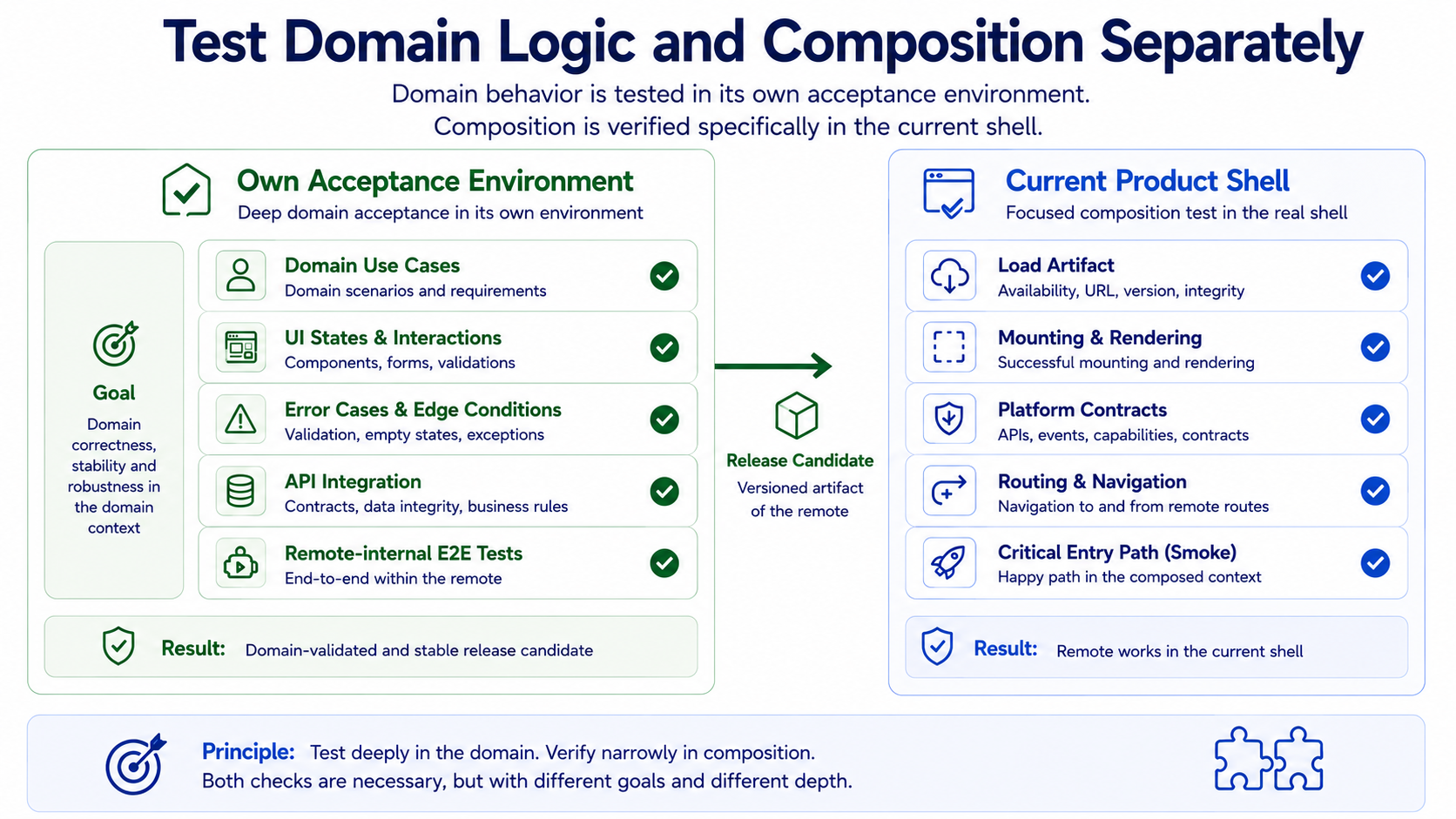
Section titled “Domain Behavior Is Validated in the Dedicated Environment”The dedicated remote or SCS environment is the place for deep domain validation. The use cases of the product area, UI behavior, validation, local navigation, error and empty states, and authorization projections should be tested there. The interaction with owned APIs and domain end-to-end scenarios within the same slice also belong in this environment.
Those tests may be extensive. They may exercise different data situations, identities, and failure states. They may cover internal navigation and several domain steps. The responsible team owns both the necessary domain knowledge and the ability to assign failures directly.
Domain validation belongs where the domain responsibility lives.
The shell should therefore not serve again as the complete test environment for every form rule, internal state variant, and local use case. Otherwise, the composition layer gradually becomes a central validation platform for every product area.
The Composition Is Verified in the Real Shell
Section titled “The Composition Is Verified in the Real Shell”After independent validation, a targeted integration test against the current production shell or the shell version intended for the release remains necessary.
Target Shell+Remote Release Candidate└── Composition Smoke TestThis test does not repeat all domain behavior. It verifies whether the releasable artifact works in the real composition. That includes whether it is reachable, can be loaded and activated, and mounts and unmounts correctly. The real route has to be accessible. AuthContext, theme, locale, and other platform contracts have to arrive correctly.
At least one critical entry into the product area should work. Navigation to and from the remote must remain intact. The remote must not impair the rest of the shell. A defined failure state should also be rendered as intended by the real platform.
Domain behavior is validated in the dedicated validation environment. Composition is verified in the real shell.
The composition test remains deliberately small. It proves that two independently validated areas of responsibility fit together in their current combination. It is not a second full domain validation and not a replacement for the deeper tests of the remote.
Product-Wide E2E Tests for Product-Wide Risks
Section titled “Product-Wide E2E Tests for Product-Wide Risks”Complete end-to-end tests remain useful when a use case genuinely spans several product areas.
Login→ navigate to Remote A→ perform domain change→ backend state is updated→ switch to Remote B→ product-wide projection becomes visibleThis flow carries a product-wide risk. It depends not only on the domain behavior of one remote or on its platform contract, but on a domain result that becomes visible across several responsibility boundaries. That is exactly when a system-wide test is appropriate.
It is not useful to validate every local form rule or internal remote function through the complete shell, every remote, all backends, and a shared full-system environment. Such tests are slow, expensive, and difficult to diagnose. More importantly, they shift local responsibility into a central pipeline.
Product-wide tests validate product-wide risks. They should not replace the local test strategy of every remote.
The larger the test environment, the more selective the scenarios validated there should be. A small set of genuinely product-wide flows is usually more robust than a large collection of local detail tests that merely happen to navigate through the complete product.
Affected Strategies Select the Relevant Checks
Section titled “Affected Strategies Select the Relevant Checks”Not every change affects every remote, and not every change requires every validation stage. Affected strategies help limit the effort based on changes and modelled dependencies.
Change in Pull Request │ ▼Affected Analysis │ ├── build affected remotes ├── run relevant tests ├── provision required preview └── verify affected compositionA monorepo tool such as Nx can use its project graph and changed inputs to determine which projects or targets may be affected. Builds, unit and component tests, contract tests, end-to-end tests, preview deployments, or composition smoke tests can then be selected accordingly.
Affected analysis is not its own test type and not a quality guarantee. The strategy decides which checks appear relevant because of a change. It does not decide how deeply those checks must validate.
Affected determines what should be checked because of a change. It does not determine how deep that validation must go.
The quality of the selection depends on a correctly modelled project and dependency graph. Hidden runtime coupling, dynamic configuration, or external contracts may be missed by static analysis. A green affected pipeline therefore does not automatically prove the real composition. It reduces effort deliberately, but it does not replace an explicitly designed integration strategy.
Validate Supported Version Combinations, Not Every Possible One
Section titled “Validate Supported Version Combinations, Not Every Possible One”Independent releases create several potentially combinable versions. A complete matrix does not scale.
multiple shell versions× multiple remote versions× additional remotes× several browsers= barely manageable test matrixThe architecture should therefore define which combinations are actually supported. Commonly relevant combinations include the current production shell with a new remote candidate and a new shell with the currently deployed remotes. During a migration, old and new contract versions or variants that are actually active in parallel may also be tested.
Not every technically possible version combination is a supported product configuration.
The promised support range should be tested, not every historical combination. That limitation is not a compromise on quality. It is a prerequisite for validating the important combinations reliably.
Smoke Tests for the Published Artifact
Section titled “Smoke Tests for the Published Artifact”Every check before deployment concerns a release candidate. Those checks cannot prove that exactly this artifact is available at the real address and is being loaded by the production shell.
A small smoke test should therefore follow publication.
published artifact├── reachable├── activatable├── central route works├── critical entry works└── no immediate increase in error rateThe test may have both technical and a small domain component. It can verify that the remote artifact is reachable, that its manifest or entry point is valid, that mounting succeeds, and that the authentication context is recognized. A small, safely repeatable read use case can serve as the domain entry point. At the same time, telemetry should show no immediate increase in errors.
This smoke test does not repeat the full validation. It answers a different question.
Before release, the candidate is validated. After release, the product verifies that this exact artifact has actually arrived.
Independent Validation Without Isolated Self-Confidence
Section titled “Independent Validation Without Isolated Self-Confidence”In the end, the following picture may still remain:
Remote Tests       ✅Contract Tests     ✅Preview Validation ✅Shell Tests        ✅
Composition        ?
The answer is not one permanently complete product pipeline. It is a deliberately layered validation strategy: an independently releasable remote needs a validation environment that its team can provision and control independently. That environment may use stubs, real backends, ephemeral infrastructure, or an independently runnable domain SCS. What matters is not its maximum size, but whether it represents the responsibility and risk of the release realistically.
Green component pipelines are not the problem. The problem is an architecture in which nobody validates the composition. The integration has to be verified without pulling all domain validation back into one central pipeline.
A release is not independent if validating it still requires the entire product.