What Do Microfrontends Really Cost?
“Surely This Will Make Everything More Expensive”
Section titled ““Surely This Will Make Everything More Expensive””“Then we need more pipelines, more deployments, more monitoring, and more infrastructure. That can only make things more expensive.”
The objection is valid. More deployables create additional technical responsibility. Pipelines have to be maintained, artifacts stored, configuration managed, routing rules operated, and failures diagnosed. Teams need skills that may previously have existed in only a few places around one centrally operated frontend. A poor platform multiplies this effort instead of reducing it.
Microfrontends are not free.
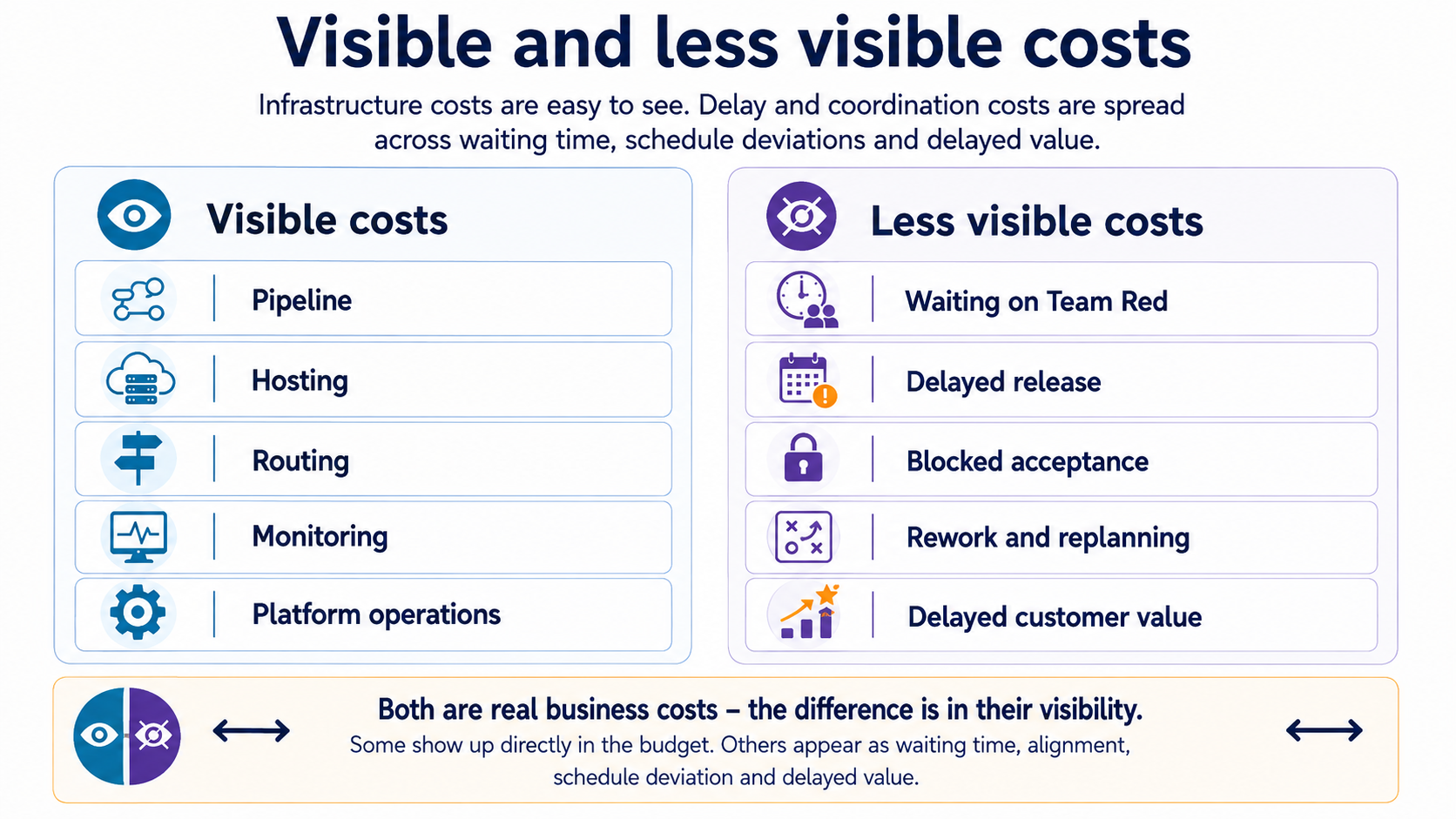
The discussion becomes incomplete, however, as soon as it considers only the visible additional costs. A pipeline can be counted. A container appears in an infrastructure overview. A dashboard has an owner and requires maintenance. The consequences of coupled change, by contrast, are spread across waiting time, replanning, and delayed value.
visible additional costs├── pipeline├── artifact├── hosting├── routing├── monitoring└── platform operations
less visible existing costs├── waiting for other teams├── coupled releases├── central approvals├── blocked test environments├── full regression testing├── repeated replanning└── delayed customer value
The visible cost of another deployable is easy to count. The cost of a coupled organization rarely appears on its own invoice.
That is why the common idea of a “microfrontend tax” is too narrow. Microfrontends increase visible platform and autonomy costs. A well-structured and well-operated architecture can, in return, reduce less visible but often substantial costs caused by waiting, cross-team coordination, central approvals, and coupled releases.
The question is not only what another deployable costs. It is also which existing costs it replaces.
Visible Costs Are Real Costs
Section titled “Visible Costs Are Real Costs”An additional dynamic remote may require its own build, pipeline, artifact storage, hosting, routing, runtime configuration, secrets, logs, metrics, alerting, and security updates. Depending on the operating model, container images, additional Kubernetes workloads, ingress or gateway rules, separate domains, dedicated dashboards, or additional documentation may also be required.
Remote├── build├── pipeline├── artifact storage├── hosting or CDN├── routing├── configuration├── secrets├── logs├── metrics├── alerting└── security updatesThese costs should not be downplayed. Another build can fail. Another runtime configuration can be wrong. An additional route has to be secured, documented, and observed. More independently released units increase the demands on version identification, diagnostics, and incident response.
The term microfrontend does not, however, determine how many containers, pods, or servers a product needs.
A statically integrated remote can be part of an existing artifact. A dynamic remote can be delivered through a CDN, object storage, or an existing web server. Several frontend areas can run on the same technical foundation. Conversely, even one frontend can require sophisticated infrastructure because of regional delivery, preview environments, and multiple runtime configurations.
Infrastructure cost should therefore be evaluated against the actual deployment model, not the number of domain-oriented frontend areas.
Kubernetes is neither a counterargument nor an automatic solution. A cluster does not make another deployable free. It can provide standardized operating mechanisms, but it also creates platform cost and requires skills, maintenance, and clear responsibility.
What Modern Platforms Actually Change
Section titled “What Modern Platforms Actually Change”The historical cost of distributed deployments was real. Many organizations operated systems in which servers were configured manually, deployment scripts maintained individually, environments configured differently, and monitoring assembled separately for each application. Operational responsibilities were unclear, rollbacks were risky, and distributed failure patterns were difficult to understand.
Those experiences are not misunderstandings. They explain why additional deployables are still associated with additional risk.
Modern platforms can standardize much of this recurring effort. Kubernetes, ingress controllers, gateways, GitOps, declarative configuration, pipeline templates, and standardized observability are possible building blocks. The important factor is not the individual tool, but the platform standard that teams can reuse.
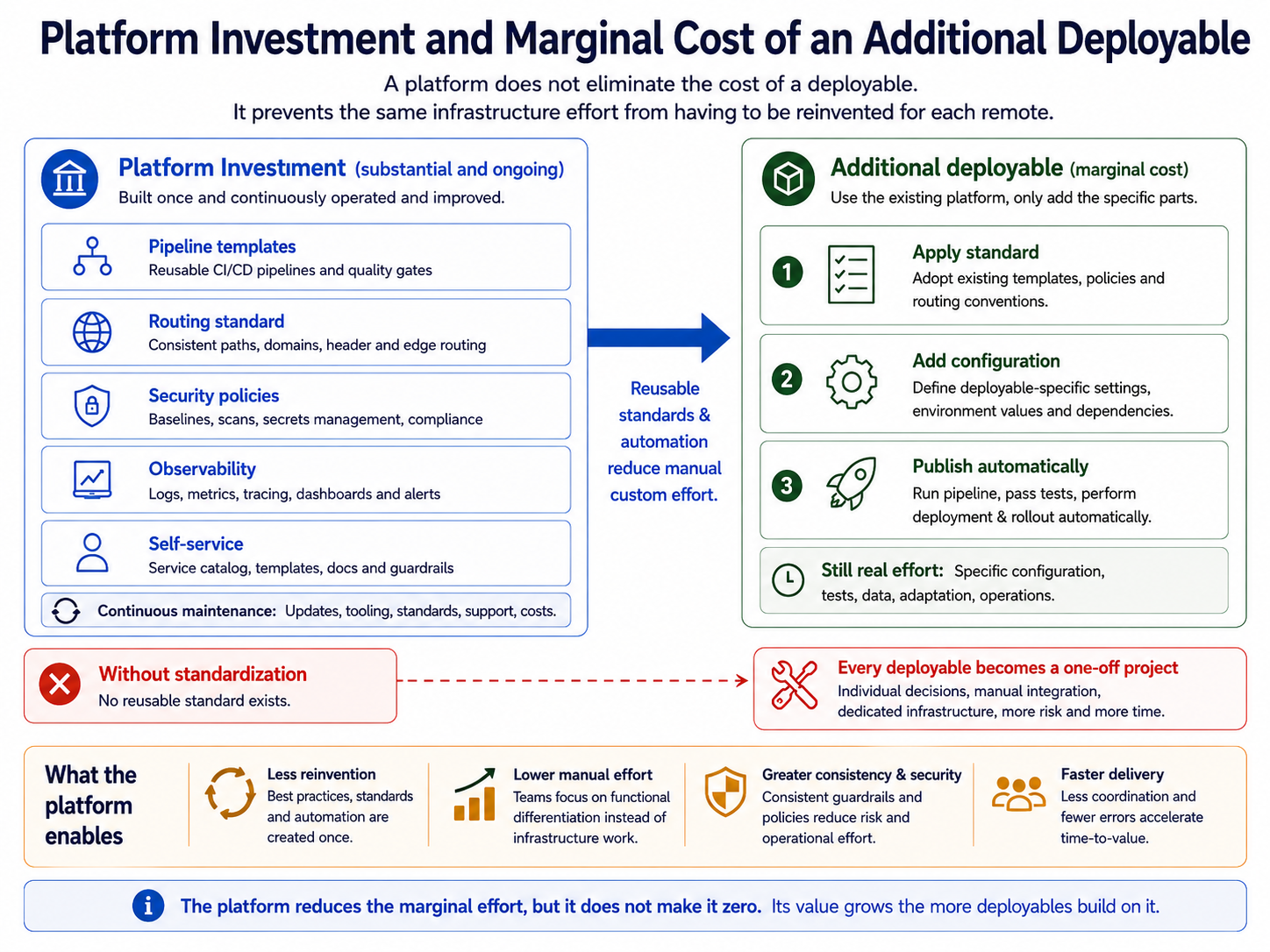
new deployable├── reusable pipeline├── standardized artifact├── declarative runtime configuration├── existing routing template├── observability requirements├── security policies└── automated deploymentThe first reliable deployment model is expensive. It has to be developed, secured, documented, and proven under real conditions. Further deployables can reuse that investment. Marginal effort falls when a new remote does not become another custom infrastructure project.
Automation does not eliminate infrastructure costs. It makes them repeatable and predictable.
A modern platform does not make another deployable free. It prevents every deployable from being treated as a unique infrastructure project. The economic question is therefore not only how many deployables exist, but how much manual special handling each additional deployable requires.
The Platform Is an Investment of Its Own
Section titled “The Platform Is an Investment of Its Own”A viable platform is more than a repository containing a few YAML files. It includes pipeline templates, artifact management, deployment standards, configuration management, security policies, observability, incident processes, documentation, self-service, support, and ongoing updates and migrations.
This work takes time and needs ownership.
Platform costs do not disappear. They are invested centrally so that recurring product costs can fall. This is economically worthwhile only when the standards are reused, remain understandable, and allow teams to work independently.
A poor platform can produce the opposite result:
every team needs→ ticket to the platform team→ individual approval→ manual configuration→ waiting timeTechnical standardization may have been promised, but operationally a new central dependency has been created. The platform team becomes part of the critical path of every release. Local release capability exists only on the architecture diagram.
A platform reduces cost only when teams can use its standards independently. A ticket portal for every deployment is not autonomy.
Self-service does not mean that every team makes arbitrary infrastructure decisions. Good platforms deliberately limit options. They provide safe and understandable paths that teams can use without repeated case-by-case approval. The platform standard does not remove responsibility. It distributes responsibility in a controlled way.
The Status Quo Is Not Free
Section titled “The Status Quo Is Not Free”Infrastructure decisions are often compared with an apparently free starting point. The existing product already has a pipeline, a deployment, and monitoring. Another remote is visibly added. The calculation therefore seems obvious.
The current state is not free. Its costs simply rarely appear on a separate invoice.
A coupled product may look like this:
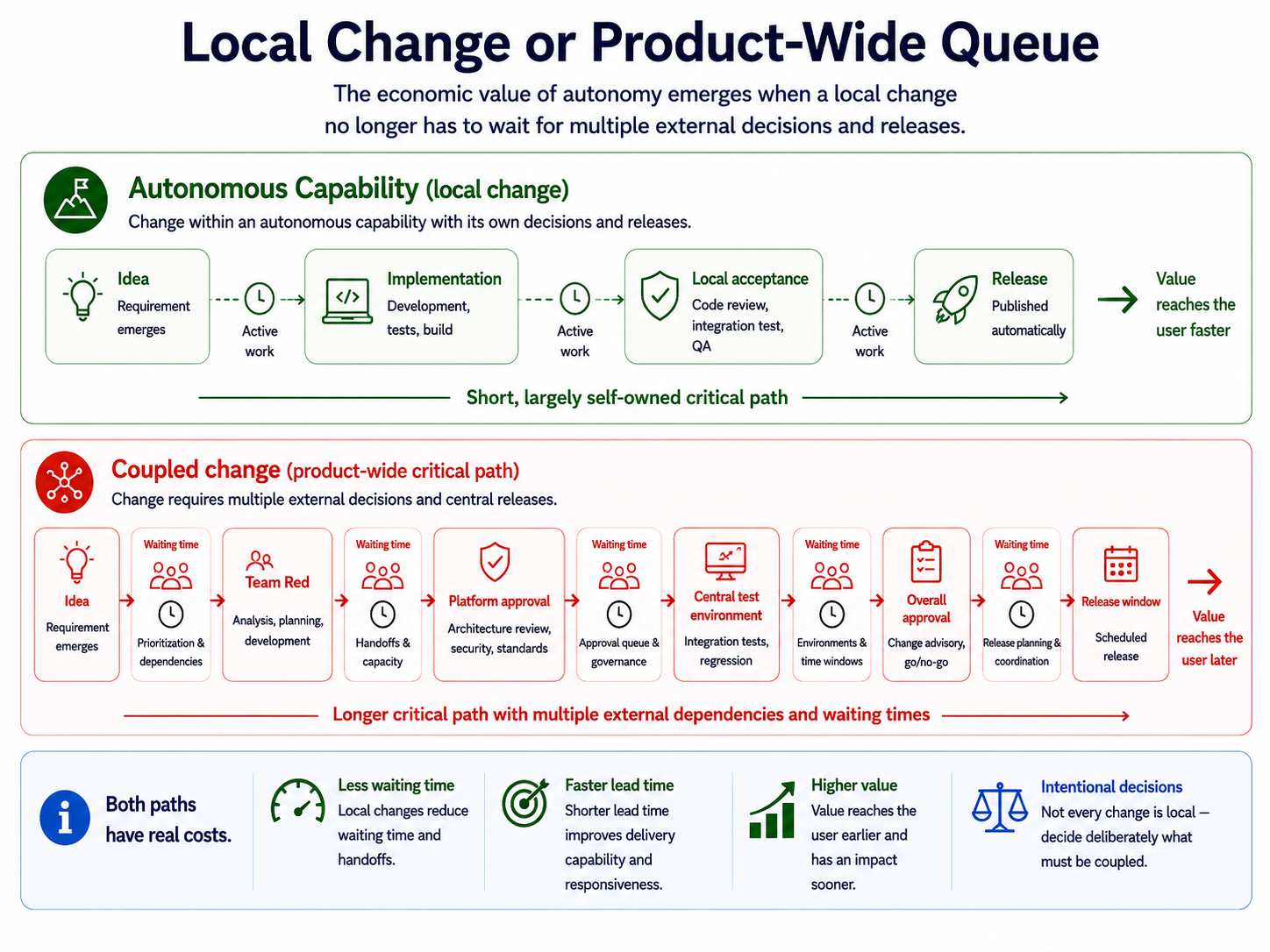
local change├── needs a fix from Team Red├── waits for Team Red to prioritize it├── needs the shared test environment├── waits for product-wide acceptance├── misses the release window├── delays the stakeholder commitment└── reaches customers laterIn projects, these dependencies sound familiar:
“We are still waiting for the bug fix from Team Red.”
“We cannot release yet because the other team is not finished.”
“The feature is complete, but shared acceptance is still missing.”
“The integration environment is currently blocked.”
“We will move it into the next full-product release.”
Statements like these do not automatically prove that microfrontends are missing. They may result from prioritization, unclear responsibilities, unstable interfaces, or an unsuitable testing strategy. They do show, however, that work owned by someone else lies on the critical path of a local change.
An architecture is economically coupled when a team that has finished its work regularly has to wait for decisions, fixes, or releases from other teams.
When Finished Work Waits for Other Teams
Section titled “When Finished Work Waits for Other Teams”In complex products, development time is not the only expensive time. The time during which finished work waits for external decisions or releases is expensive as well.
Waiting begins when a change is technically complete but a dependency is still missing. During that period, the work that has already been funded provides no customer value. It exists, but it is not available.
When the expected fix finally arrives, a context switch often follows. The team has already started other work, must restore the previous context, verify integration assumptions again, and perhaps resolve new conflicts. The effort does not lie only in the actual correction, but also in rebuilding understanding.
Replanning often follows. Product owners, project leadership, and stakeholders reassess dates and dependencies. A missed release window can affect other initiatives. A regulatory change, bug fix, or promised feature arrives later even though the local implementation was completed on time.
These costs do not appear as one large invoice. They are distributed across waiting time, replanning, priority conflicts, and delayed value.
Repeatedly unreliable forecasts also have an organizational effect. Stakeholders begin to interpret commitments with hidden safety margins. Customers receive more cautious dates. Urgent changes require more escalation because nobody can say with confidence which dependencies will still emerge.
The additional ingress rule is visible. The missed release date does not appear on an infrastructure invoice.
Stakeholders Experience Architecture as Delivery Capability
Section titled “Stakeholders Experience Architecture as Delivery Capability”Stakeholders rarely assess architecture by counting its pipelines. They experience architecture as delivery capability, forecast reliability, and response speed.
Their questions are not: How elegant is the remote configuration? Their questions are:
- When will the feature be available?
- How reliable is that commitment?
- Can an urgent defect be fixed independently?
- Why is a team that has finished its work still waiting?
- Why does a local change require full regression testing?
- Why must a small fix wait for the next shared release?
Economic cost is not limited to technical effort. The lead time from a decision to available value matters just as much.
An architecture can appear to have little infrastructure and still be expensive if every change passes through long queues. Conversely, a platform may visibly operate more deployables and still be economically sensible if teams can deliver independently, assign failures more quickly, and meet commitments more reliably.
This is not a guarantee in favor of microfrontends. It simply adds the costs missing from a purely technical infrastructure calculation.
Four Cost Categories for a Complete Discussion
Section titled “Four Cost Categories for a Complete Discussion”The cost of a microfrontend architecture cannot be compressed into one exact controlling model. Four cost categories can nevertheless make the discussion more complete.
1. Platform Costs
Section titled “1. Platform Costs”Platform costs are directly visible and often highly standardizable:
- build and deployment,
- hosting and routing,
- configuration and secrets,
- artifact management,
- observability,
- security policies,
- platform maintenance.
They exist whether the platform is operated by a central team, collectively, or close to the product. Automation can reduce their marginal effort, but it cannot eliminate their existence.
2. Autonomy Costs
Section titled “2. Autonomy Costs”Autonomy costs are the deliberate price of independent units:
- independent testing capability,
- independent release capability,
- operational responsibility,
- diagnostic capability,
- necessary skills within the team,
- local documentation,
- a clear owner.
Autonomy costs are not automatically waste. They buy the ability to act.
A team expected to release independently must understand, test, observe, and take responsibility for its own area when failures occur. A separate build without diagnostic capability is not autonomy. A local release without operational knowledge merely shifts responsibility elsewhere.
Autonomy costs responsibility. Centralization costs dependency.
3. Coupling Costs
Section titled “3. Coupling Costs”Coupling costs arise when the intended boundaries fail to hold. Typical causes include shared releases, direct dependencies between remotes, global domain state, domain logic in the shell, overly broad shared libraries, unstable platform contracts, a mandatory product-wide E2E suite, or shared acceptance for local changes.
These costs can occur in both a monolith and a microfrontend architecture. In microfrontends they are particularly expensive because the organization has already paid for technical distribution without gaining independent changeability.
4. Coordination and Delay Costs
Section titled “4. Coordination and Delay Costs”This category is most often underestimated:
- waiting for other teams,
- priority conflicts,
- handoffs,
- central approvals,
- shared fault analysis,
- blocked test environments,
- release coordination,
- repeated replanning,
- delayed customer value,
- declining forecast reliability.
Not every delay can be attributed unambiguously to an architecture decision. It is still economically negligent to exclude these costs merely because they do not appear on a platform invoice.
A Missing Test Strategy Is a Cost Driver
Section titled “A Missing Test Strategy Is a Cost Driver”A remote can be built separately and still be impossible to validate separately.
every change→ start the complete product→ occupy the central test environment→ run every E2E test→ wait for shared approvalThis model contains several deployables, but every local change remains coupled to complete product acceptance. The pipeline landscape is distributed. Lead time is not.
A more viable test strategy distinguishes more clearly:
local change├── unit and component tests├── contract tests├── remote acceptance in its own environment└── targeted composition tests in the hostNot every test can remain local. Integration still has to be verified. Product-wide E2E tests do not disappear entirely. Critical user journeys, navigation, authentication, and cross-domain business processes still require shared tests.
Most local changes, however, should not require the complete product. Otherwise the central test environment remains permanently on the critical path of every change.
A missing test strategy is often booked as an unavoidable microfrontend cost, even though it actually demonstrates that acceptance is not independent.
Unclear Ownership Extends Every Incident
Section titled “Unclear Ownership Extends Every Incident”Technical distribution without clear responsibility makes operations harder:
failure in the product├── shell team investigates├── remote team investigates├── platform team investigates├── backend team investigates└── nobody owns the overall diagnosisWithout clear ownership, handoffs, response times, and duplicate analysis increase. Teams debate responsibility while the incident continues. Information is collected several times, log extracts are passed around, and assumptions move between groups. Incident duration grows not only because of technical complexity, but because decision authority is missing.
An autonomous unit therefore needs more than its own build. It needs a known owner, understandable logs and metrics, operational knowledge, defined escalation paths, and responsibility for failures and releases.
A remote without a clear owner is not an autonomous product area. It is only another technical unit.
Ownership does not mean one team must solve every failure alone. Platform, backend, and shell teams remain important partners. What matters is knowing who leads the diagnosis, who makes decisions, and who owns the status communicated to stakeholders.
Observability Is Operational Capability
Section titled “Observability Is Operational Capability”Several remotes increase the demands on diagnostics. Failures must be correlatable. Their technical origin, remote version, and runtime configuration must remain visible. Loading and activation failures must not disappear into a generic “frontend error”. Availability, performance, and relevant user journeys need understandable signals.
Observability is therefore not a luxury. It is part of operational capability.
Additional metrics, dashboards, and alerts naturally create platform costs. The alternative is not free. Missing diagnostic capability leads to longer incidents, cross-team searches, and unclear responsibility. A small technical defect can thereby trigger a large organizational investigation.
The economic value of good observability is not limited to detecting a failure. It lies in shortening the path from observation to the responsible unit and to a sound decision.
Good Governance Reduces Case-by-Case Coordination
Section titled “Good Governance Reduces Case-by-Case Coordination”A design system and governance also create costs. Components, tokens, accessibility rules, documentation, and versions have to be developed and maintained. Shared rules do not appear by themselves.
A design system can support visual consistency, avoid repeated individual decisions, standardize accessibility requirements, and provide shared interaction patterns. It becomes expensive, however, when every local deviation requires central approval, product teams have no clear extension points, or versions can only be adopted synchronously.
The design system then becomes a UI monolith, and its governance becomes part of the critical path of local product work.
The same applies to architecture governance. Good governance replaces repeated case-by-case coordination with a small number of stable rules. Poor governance turns every local decision into a central committee matter.
Shared concerns remain necessary: product strategy, user experience, security, compliance, design tokens, platform contracts, navigation, and cross-domain business processes. What matters is not whether teams communicate, but whether the same coordination has to be repeated for every local change.
shared investment├── capability boundaries├── platform contract├── design tokens├── deployment standard├── observability standard└── ownership
then enables
local changes└── without repeated product-wide coordination
A good microfrontend architecture does not eliminate communication. It removes unnecessary synchronization from the critical path of local changes.
A Poor MFE Architecture Really Is Expensive
Section titled “A Poor MFE Architecture Really Is Expensive”The objection about additional cost is especially valid when technical distribution is introduced without reducing coupling.
several remotesbut:├── one shared approval├── one central test environment├── synchronized releases├── global domain state├── direct dependencies├── unclear ownership├── an overloaded platform group└── product-wide regression for every changeThe result is additional platform cost, additional integration cost, and unchanged coordination cost at the same time.
Microfrontends become expensive when technical distribution is introduced without reducing domain, organizational, and operational coupling.
Autonomy that the organization is not allowed to use is merely additional architecture. A team may be technically able to create a local release. If it still needs central approval, a shared release window, and full-product acceptance, the economic benefit has not been realized.
The problem is not exclusively technical. An organization can allow independent deployments and still prevent local decisions. Conversely, a modular monolith can be highly efficient in a small, well-coordinated organization.
Microfrontends become expensive when autonomy is only claimed.
When Microfrontends Are Not Worth the Investment
Section titled “When Microfrontends Are Not Worth the Investment”Not every large frontend needs microfrontends. Not every organizational delay can be solved through technical decomposition.
The investment is probably unsuitable when one small team develops the entire product, all areas are released together anyway, little parallel change occurs, or the domain is strongly interconnected. The same applies when platform automation does not exist, teams cannot assume operational responsibility, local decisions are not permitted organizationally, or every change necessarily requires shared acceptance.
In such situations, the product pays platform, integration, and autonomy costs without being able to use autonomy economically.
A large number of organizational problems is not by itself an argument for microfrontends. Unclear prioritization, missing product responsibility, and poor collaboration are not fixed by additional deployables. A technical boundary can support responsibility, but it cannot replace a decision-making culture.
Microfrontends are not a substitute for clear product ownership, prioritization, or good collaboration.
The relevant question is therefore not whether microfrontends appear modern. It is whether independent paths of change create recurring economic value in the specific product.
Which Costs Autonomy Can Replace
Section titled “Which Costs Autonomy Can Replace”The economic case becomes more plausible when several teams deliver in parallel, product areas change at different rates, and releases should not be synchronized. Teams must be able to own their capability end to end. Platform tasks should be standardized, contracts stable, failures clearly attributable, and changes mostly testable locally.
Two paths of change can then genuinely differ.
Autonomous Change
Section titled “Autonomous Change”idea→ local decision→ local implementation→ local acceptance→ independent releaseCoupled Change
Section titled “Coupled Change”idea→ cross-team coordination→ external dependency→ shared integration→ full regression→ release coordination→ shared releaseThe autonomous path is not free from effort. It requires testing, ownership, observability, operational responsibility, and a reliable platform standard. The difference lies in the critical path: work owned by someone else does not regularly have to be completed before a local change can become available.
A local change becomes economically valuable when it can be decided, tested, and released locally.
The economic benefit comes less from cheaper servers than from shorter paths of change. Microfrontends can be economically viable because a local change no longer has to wait for the entire product.
The Fair Economic Comparison
Section titled “The Fair Economic Comparison”A real microfrontend model is often compared with an idealized monolith.
Microfrontends├── additional pipelines├── additional artifacts├── additional deployments└── additional observability
versus
Monolith└── apparently no additional costs
That comparison is incomplete. A realistic comparison contrasts the cost of distributed autonomy with the cost of coupled change:
cost of distributed autonomy
versus
cost of central coordination├── longer pipelines├── broader regression├── shared releases├── blocked teams├── central approvals├── large change radii└── delayed value
The fair comparison is not “microfrontends versus no additional cost”. It is “the cost of distributed autonomy versus the cost of coupled change”.
Anyone who counts only additional deployables is calculating precisely in the wrong place.
A serious assessment therefore asks not only what another deployment, pipeline, or dashboard costs. It also asks what a delayed release, two weeks of waiting for another team, product-wide regression for a local change, a blocked integration environment, a missed customer commitment, or a hotfix postponed until the next full-product release costs.
Not all of these costs can be monetized exactly. That does not make them meaningless. An architecture decision does not become economical merely because its costs remain invisible.
Microfrontends make some costs visible. The status quo hides others in lead times, queues, and missed dates.
Not Cheaper Development, but More Independent Change
Section titled “Not Cheaper Development, but More Independent Change”Microfrontends are not automatically cheaper. They increase visible costs for platforms, operations, testing, and local responsibility. Those costs are real and have to be managed through standards, automation, and clear ownership.
Modern platforms standardize infrastructure costs but do not eliminate them. They reduce the marginal effort of another deployable when existing pipeline templates, routing rules, security policies, observability requirements, and self-service processes can be reused. The platform itself remains a product with development and maintenance costs.
Large coupled systems also create substantial costs. They appear as waiting time, cross-team dependencies, blocked acceptance, shared releases, replanning, and delayed customer value. Stakeholders experience these architecture costs as poor delivery capability, unreliable commitments, and slow responses to urgent requirements.
A good microfrontend architecture is not economically viable because another deployable is free. It can be economically viable because local changes remain local and work owned by other teams no longer regularly lies on their critical path.
That autonomy requires independent testing capability, ownership, observability, and operational responsibility. Good governance creates stable rules so that every local decision does not have to be coordinated product-wide again. Technical distribution without organizational decoupling, by contrast, increases cost because platform and integration effort are added while existing queues remain.
The current state is not free. Autonomy costs responsibility. Centralization costs dependency.
The real cost question is not how many deployables a product operates, but how many teams have to be synchronized for a single change.